
01
Executive overview
Key findings
2.18 billion m³: design flood-control capacity of the 20 multipurpose dams; K-Water secured more than three times this space before the 2025 flood season
1,072,000 tonnes a day: planned integrated industrial water supply for the Yongin semiconductor cluster, in two phases to 2034
KRW 432.8 per m³: bulk treated water tariff, unchanged since September 23, 2016; bulk water cost recovery 78.1% in 2025
14 → 5: new climate-response dams going ahead for further study after the August 27, 2026 review
02
Buyer relevance
Who the report is for
Water policy officials and regulators
See which body holds each layer of the system, from the ministry and the dam committee to municipalities, alongside the 78.1% bulk cost recovery in 2025.
Industrial water users and cluster planners
Compare Yongin phase 1 at 310,000 tonnes a day from May 2029 with phase 2 at 760,000 to 762,000 tonnes a day from existing dams and reclaimed water.
Engineering and desalination firms
Weigh the 5 remaining dams, the 100,000 tonnes a day Daesan plant and municipal consignments such as Yeongju when planning work to 2030.
Lenders and credit analysts
Read the 94.5% government stake, equity injections of about KRW 400 billion a year and the KRW 410.2 billion bulk cost gap in 2025 together.
03
Decision scope
Questions answered
How much storage does the national system rely on?
The ministry managed 34 dams in 2022, 20 of them multipurpose, with a design flood-control capacity of 2.18 billion m³ at the multipurpose dams.
What happened to Korea's new-dam plans?
The August 27, 2026 review kept 5 of 14 proposed dams for further study and cut estimated cost from KRW 4.75 trillion to about KRW 1.67 trillion.
Where is new supply coming from instead?
From conveyance and desalination: the Daesan plant adds 100,000 tonnes a day, and the Yongin project plans 1,072,000 tonnes a day by 2034.
Who sets K-Water's bulk tariff, and when did it last change?
The last increase, 4.8% from September 23, 2016, was announced by the Ministry of Land, Infrastructure and Transport; bulk cost recovery was 78.1% in 2025.
04
Inside the report
Inside the complete report
Executive Overview
1. Water Resource Profile
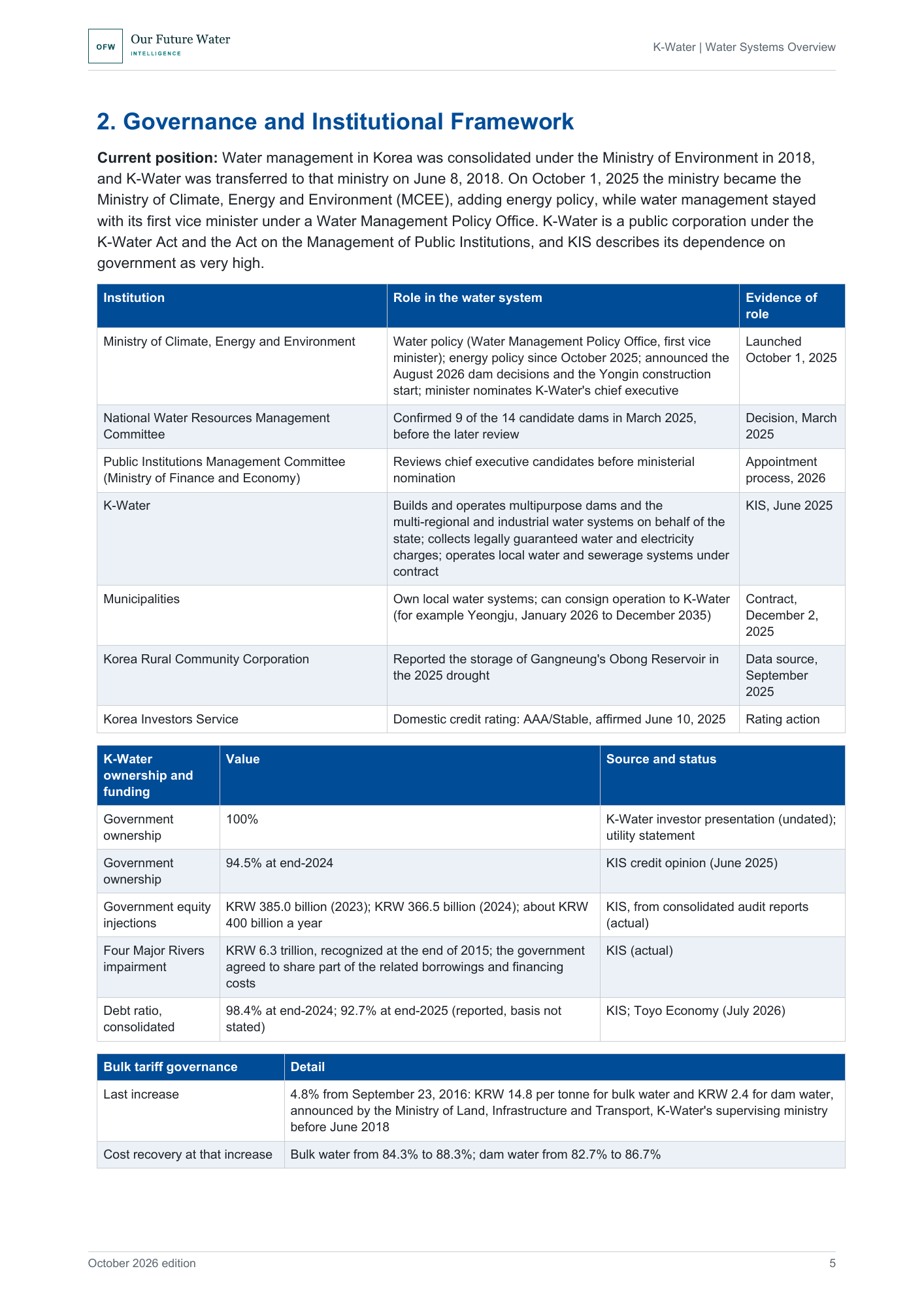
2. Governance and Institutional Framework
Strategic Outlook and Opportunities
Source Register
05
Public preview
What to watch next
1. Water Resource Profile
Feasibility results for the five dams; Daesan's first full year of operation; how Han River dam storage is allocated once Yongin phase 1 begins supply in 2029.
2. Governance and Institutional Framework
The chief executive appointment; any MCEE announcement on bulk or dam water tariffs; further municipal consignments to K-Water.
Strategic Outlook and Opportunities
Yongin lot 1 and lot 3 awards, with bidders to be selected December 18, 2026 (planned); the five dams' feasibility results; FY 2025 audited accounts; any tariff decision; the next KIS review.
Governance: the institutions in Korea's water system, K-Water ownership and funding, and bulk tariff history
06
Included
What you receive
The complete PDF report: 9 pages, 5 sections, 8 tables and a register of 19 sources.
This edition
October 2026, First edition.
07
Evidence & method
Evidence and method
The report draws on ministry announcements and policy briefings on dams, drought and industrial supply, the June 2025 KIS credit opinion with K-Water's consolidated results, the 2016 tariff decision, and Korean news reports of K-Water statements, contracts and leadership, checked to October 31, 2026.
Sources
19 sources, listed in the report's source register. Evidence current to 31 October 2026. Principal data periods: FY 2024 consolidated results (year ended December 31, 2024); FY 2025 reported results; 2024–2026 national water decisions. Project and policy status checked on October 31, 2026. All currency is Korean won (KRW)..
Evidence boundaries
This report uses authoritative source material available at the stated research cutoff. It distinguishes published facts, calculated values and analytical interpretation. No independent modelling is performed. Forward-looking analysis reflects published plans, documented trends and stated uncertainties. It does not constitute legal, financial, investment or engineering advice.
08
Lead analyst
Robert C. Brears
Founder, Our Future Water Intelligence
Robert C. Brears is a water-security specialist and author whose work examines utility governance, infrastructure investment, climate resilience and long-term water-system change for executive and policy audiences.
- Decision-focused utility intelligence
- Published water-policy author
- Evidence-grounded system analysis
09
Buyer FAQs
Before you purchase
Who can use the report?
Licensed for internal use within one purchasing organization. The PDF and its contents may be shared with colleagues within that organization. External redistribution, resale and public publication are prohibited without permission.
How is the report delivered?
The PDF is available to download immediately after confirmed payment, through our secure delivery system.
Can my organization buy wider access?
Institutional purchasing: For invoice enquiries, multi-organization licensing or broader access requirements, contact Our Future Water Intelligence.
10
Water Systems Overview: K-Water
- Format
- Length
- 9 pages
- Edition
- October 2026, First edition
- Price
- USD 499
11
Report details
Publication details
- Publisher
- Our Future Water Intelligence
- Report family
- Water Utility Intelligence Report
- Edition
- October 2026, First edition
- Format
- Length
- 9 pages
- Reference
- OFW_EXT_WATER_SYSTEMS_OVERVIEW_K_WATER_822efec5d79c
- Evidence current to
- 31 October 2026
14
Explore this report family
More Water Systems Overview reports
Explore the same report family covering other utilities.
Water Systems Overview: Watercare Services
- Geography
- Auckland (Tāmaki Makaurau), New Zealand
- Edition
- November 2026, First edition
- Length
- 12 pages
Water Systems Overview: Acea
- Geography
- Rome and ATO 2 Lazio Centrale, Italy
- Edition
- November 2026, First edition
- Length
- 10 pages
Water Systems Overview: Johannesburg Water
- Geography
- City of Johannesburg, Gauteng, South Africa
- Edition
- November 2026, First edition
- Length
- 11 pages