
01
Executive overview
Key findings
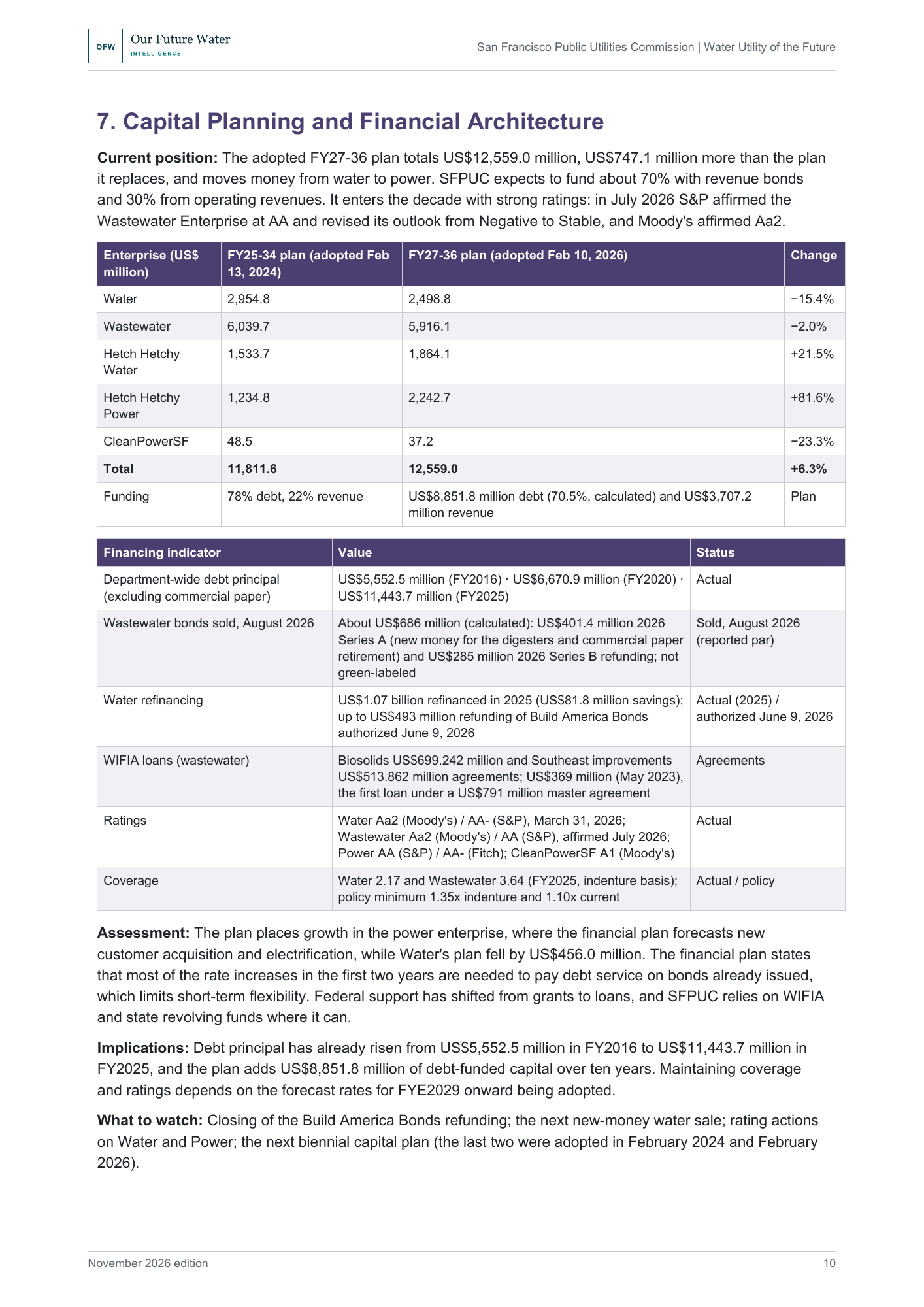
US$12,559.0 million: 10-year capital plan for FY2026-27 to FY2035-36, adopted February 10, 2026; about 70% debt-funded (plan)
US$2,242.7 million: Hetch Hetchy Power 10-year capital, up 81.6% on the previous plan, for new substations, grid connections and carbon-free steam (plan)
48 of 52: regional Water System Improvement Program projects complete; Regional program forecast to finish June 30, 2032 (status, July 2026)
US$1,470.3 million: Southeast Treatment Plant nutrient reduction project, described in the plan as its single largest capital investment, forecast for November 2039 (approved budget)
02
Buyer relevance
Who the report is for
Power and grid equipment suppliers
Size the substation, transmission and grid-connection program behind the US$2,242.7 million Hetch Hetchy Power plan and its milestones.
Engineering and construction firms in wastewater and flood resilience
Track the nutrient removal, Ocean Beach, Folsom and Lower Alemany projects, their forecast dates and re-advertised contracts.
Municipal bond investors and rating analysts
Read the 70% debt-funded plan against debt principal of US$11,443.7 million in FY2025 and the adopted 15.0% and 14.5% sewer increases.
Digital water and metering vendors
See where SCADA, remote valve control and the AMI refresh for 178,000 accounts sit in the adopted plan.
03
Decision scope
Questions answered
Where is SFPUC putting its capital growth?
Into power: Hetch Hetchy Power rises 81.6% to US$2,242.7 million, while the Water plan falls 15.4% to US$2,498.8 million.
When does the Water System Improvement Program finish?
The Regional program is forecast for June 30, 2032, with 48 of 52 regional projects complete and US$4,689.7 million of US$4,792.8 million spent.
What is the largest single project in the plan?
The Southeast Treatment Plant nutrient reduction project at US$1,470.3 million, forecast for November 29, 2039.
When could bills exceed SFPUC's affordability targets?
The FY27-36 Financial Plan says beginning in FY 2033-34; the Capital Plan says in FY 2035. Both show the bill back under target by FY2044-45 or FY2045.
04
Inside the report
Inside the complete report
Executive Snapshot
1. From Service Provider to System Operator
2. System Intelligence and Digital Control
3. Energy, Carbon, and Resource Decoupling
4. Infrastructure Strategy for a Non-Stationary Climate
5. Customers, Demand, and the Water Prosumer
6. Governance, Regulation, and Institutional Reform
7. Capital Planning and Financial Architecture
8. Workforce, Capability, and Organizational Change
9. Strategic System Roadmap
Conclusion
Source Register
05
Public preview
What to watch next
4. Infrastructure Strategy for a Non-Stationary Climate
Re-advertised bids for Lower Alemany and Folsom; Coastal Commission action on the Ocean Beach redesign; the nutrient project's chosen alternative; Regional Groundwater Storage and Recovery completion in December 2027.
5. Customers, Demand, and the Water Prosumer
Discount-program enrollment; the FYE2029-FYE2030 rate proposals; the next Financial Plan's affordability forecast.
6. Governance, Regulation, and Institutional Reform
Appointment of the next General Manager; the Southeast permit in February 2027; the State Water Board's handling of the Tuolumne; the CPUC valuation decision.
7. Capital Planning and Financial Architecture
Closing of the Build America Bonds refunding; the next new-money water sale; rating actions on Water and Power; the next biennial capital plan (the last two were adopted in February 2024 and February 2026).
Section 7 compares the FY25-34 and FY27-36 capital plans by enterprise and sets out the financing behind them.
06
Included
What you receive
The complete PDF report: 15 pages, 12 sections, 14 tables and a register of 28 sources.
This edition
November 2026, First edition.
07
Evidence & method
Evidence and method
Built from SFPUC's adopted FY2026-27 to FY2035-36 Capital and Financial Plans, its quarterly capital program reports for the quarter ended June 30, 2026, the audited FY2025 financial report and the April 2026 rate decision. Regulatory status draws on State Water Board, court and City Controller documents.
Sources
28 sources, listed in the report's source register. Evidence current to 13 November 2026. Principal data periods: FY2025 audited results (year ended June 30, 2025); 10-Year Capital and Financial Plans for FY2026-27 to FY2035-36 (adopted February 10, 2026); capital program quarterly reports for the quarter ended June 30, 2026; retail rates adopted April 28, 2026. All currency is US dollars..
Evidence boundaries
This report uses authoritative source material available at the stated research cutoff. It distinguishes published facts, calculated values and analytical interpretation. No independent modelling is performed. Forward-looking analysis reflects published plans, documented trends and stated uncertainties. It does not constitute legal, financial, investment or engineering advice.
08
Lead analyst
Robert C. Brears
Founder, Our Future Water Intelligence
Robert C. Brears is a water-security specialist and author whose work examines utility governance, infrastructure investment, climate resilience and long-term water-system change for executive and policy audiences.
- Decision-focused utility intelligence
- Published water-policy author
- Evidence-grounded system analysis
09
Buyer FAQs
Before you purchase
Who can use the report?
Licensed for internal use within one purchasing organization. The PDF and its contents may be shared with colleagues within that organization. External redistribution, resale and public publication are prohibited without permission.
How is the report delivered?
The PDF is available to download immediately after confirmed payment, through our secure delivery system.
Can my organization buy wider access?
Institutional purchasing: For invoice enquiries, multi-organization licensing or broader access requirements, contact Our Future Water Intelligence.
10
Water Utility of the Future: San Francisco Public Utilities Commission
- Format
- Length
- 15 pages
- Edition
- November 2026, First edition
- Price
- USD 499
11
Report details
Publication details
- Publisher
- Our Future Water Intelligence
- Report family
- Water Utility Intelligence Report
- Edition
- November 2026, First edition
- Format
- Length
- 15 pages
- Reference
- OFW_EXT_WATER_UTILITY_OF_THE_FUTURE_SAN_FRANCISCO_PUBLIC_UTILITIES_COMMISSION_9e41261e020a
- Evidence current to
- 13 November 2026
14
Explore this report family
More Water Utility of the Future reports
Explore the same report family covering other utilities.
Water Utility of the Future
Water Utility of the Future: Department of Energy, Abu Dhabi Emirate
- Geography
- Abu Dhabi, United Arab Emirates
- Edition
- November 2026, New edition
- Length
- 16 pages
Water Utility of the Future
Water Utility of the Future: Water and Sanitation Directorate, City of Cape Town
- Geography
- Cape Town, South Africa
- Edition
- November 2026, New edition
- Length
- 14 pages
Water Utility of the Future
Water Utility of the Future: Electricity and Water Authority
- Geography
- Bahrain, Middle East
- Edition
- November 2026, New edition
- Length
- 15 pages