
01
Executive overview
Key findings
US$1.7 billion: capital investment planned over 10 years (October 2025)
42,000 → 119,000 acre-feet: Gross Reservoir after a 131-foot dam raise, 95% complete in December 2025
More than 240,000: meters to move from radio reading to cellular advanced metering, at up to US$63 million
20%: demand reduction targeted under the Stage 1 drought declared on March 25, 2026
02
Buyer relevance
Who the report is for
Utility executives and strategy teams
A worked case of a utility moving from building assets to operating a connected system, with the run-rates for main replacement, lead removal and meters that now measure its progress.
Metering and technology suppliers
Where Denver Water's digital transition stands: more than 240,000 meters still read by vehicle, a cellular advanced metering program of up to US$63 million, and no published procurement timeline yet.
Engineering firms and contractors
The status and next phases of Gross Reservoir, the Downstream Reservoir Program, main renewal and sediment work, and which programs are most exposed to 2027 budget reductions.
Investors and public sector advisers
How drought pricing, debt growth and AAA ratings interact, and how Colorado River operating rules could shape the new Integrated Resource Plan.
03
Decision scope
Questions answered
How far has Denver Water's building program progressed?
Northwater was completed in June 2024, on schedule and under budget, and the Gross Reservoir dam raise was 95% complete in December 2025 after a court halt and a win on appeal. Main renewal runs at about 97,000 feet a year against a goal of more than 145,000.
Where does Denver Water stand on digital control?
Customer meters are still read monthly by vehicle. The report sets out the planned cellular metering rollout, what it would change in a drought, and why its value depends on how the data is used.
How does the 2026 drought affect the transition?
Revenue is expected to fall in line with a 20% demand cut; the drought surcharge offsets part of it and the rest is to come from cash reserves and budget reductions. The report identifies the programs most exposed.
Which decisions come next?
The 2027 Approved Budget, an advanced metering procurement decision, the start of Gross Reservoir filling and the new 50-year Integrated Resource Plan.
04
Inside the report
Inside the complete report
Executive Snapshot
1. From Service Provider to System Operator
2. System Intelligence and Digital Control
3. Energy, Carbon, and Resource Decoupling
4. Infrastructure Strategy for a Non-Stationary Climate
5. Customers, Demand, and the Water Prosumer
6. Governance, Regulation, and Institutional Reform
7. Capital Planning and Financial Architecture
8. Strategic System Roadmap
Conclusion
Source Register
05
Public preview
What to watch next
2. System Intelligence and Digital Control
An AMI procurement decision and a published rollout schedule; whether the first phases target high-use or drought-sensitive customers.
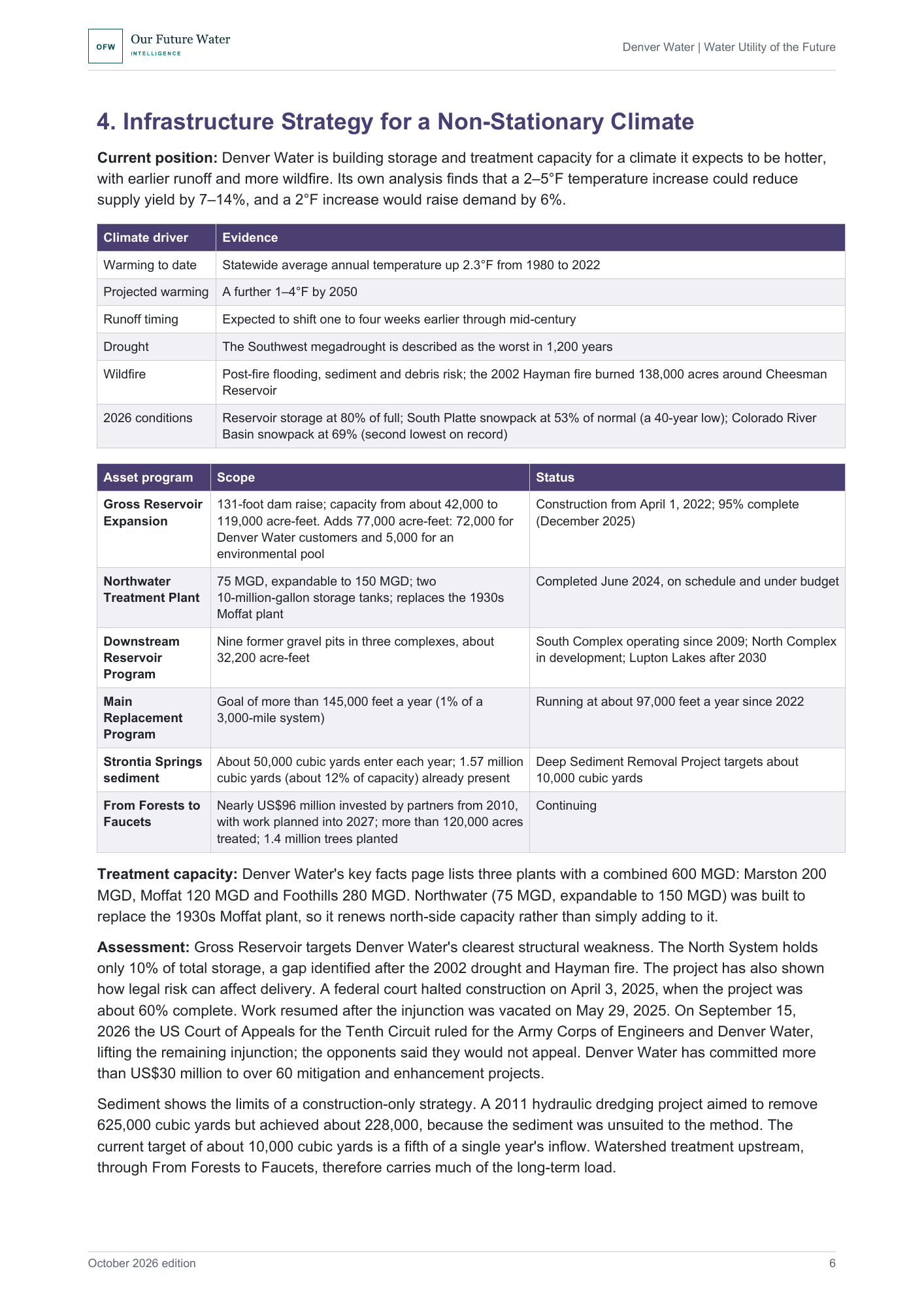
4. Infrastructure Strategy for a Non-Stationary Climate
Completion of the Gross dam raise and the start of filling; main replacement footage against the 145,000-foot goal; progress on the North Reservoir Complex.
5. Customers, Demand, and the Water Prosumer
Actual demand reduction against the 20% target; the scale of drought-related budget reductions; any Stage 2 declaration.
7. Capital Planning and Financial Architecture
The 2027 Approved Budget; any change to the 10-year plan figure; rating agency commentary after the drought year.
Infrastructure Strategy for a Non-Stationary Climate: climate drivers, the status of each major asset program and the assessment of Gross Reservoir.
06
Included
What you receive
The complete PDF report: 13 pages, 11 sections, 15 tables and a register of 34 sources.
This edition
October 2026, Second edition. Audited financial results through FY 2025. The October 2025 10-year capital plan, 2026 rates and the 2026 drought response. Gross Reservoir after the Tenth Circuit ruling of September 15, 2026. The 2027-2028 Colorado River operating decision signed on August 21, 2026. Second edition, October 2026, with evidence current to 24 October 2026. Replaces the first edition for new buyers; buyers of the first edition keep access to the edition they bought.
07
Evidence & method
Evidence and method
Built on Denver Water's audited annual financial reports, capital plans, rates and drought resolutions, water quality and sustainability reporting, and federal sources including the EPA, the Bureau of Reclamation and the Department of the Interior, with the court rulings on Gross Reservoir.
Sources
34 sources, listed in the report's source register. Evidence current to 24 October 2026. Principal data periods: FY 2025 audited results (year ended December 31, 2025); 2026 rates and drought measures; calendar 2025 water quality data. All currency is US dollars..
Evidence boundaries
This report uses authoritative source material available at the stated research cutoff. It distinguishes published facts, calculated values and analytical interpretation. No independent modelling is performed. Forward-looking analysis reflects published plans, documented trends and stated uncertainties. It does not constitute legal, financial, investment or engineering advice.
08
Lead analyst
Our Future Water Intelligence
Water-system research and reference analysis.
09
Buyer FAQs
Before you purchase
Who can use the report?
Licensed for internal use within one purchasing organization. The PDF and its contents may be shared with colleagues within that organization. External redistribution, resale and public publication are prohibited without permission.
How is the report delivered?
The PDF is available to download immediately after confirmed payment, through our secure delivery system.
Can my organization buy wider access?
Institutional purchasing: For invoice enquiries, multi-organization licensing or broader access requirements, contact Our Future Water Intelligence.
10
Water Utility of the Future: Denver Water
- Format
- Length
- 13 pages
- Edition
- October 2026, Second edition
- Price
- USD 499
11
Report details
Publication details
- Publisher
- Our Future Water Intelligence
- Report family
- Water Utility Intelligence Report
- Report type
- water utility of the future
- Edition
- October 2026, Second edition
- Format
- Length
- 13 pages
- Reference
- OFW-WUOF-DENVER-20261025-E2
- Evidence current to
- 24 October 2026
14
Explore this report family
More Water Utility of the Future reports
Explore the same report family covering other utilities.
Water Utility of the Future
Water Utility of the Future: Department of Energy, Abu Dhabi Emirate
- Geography
- Abu Dhabi, United Arab Emirates
- Edition
- November 2026, New edition
- Length
- 16 pages
Water Utility of the Future
Water Utility of the Future: Water and Sanitation Directorate, City of Cape Town
- Geography
- Cape Town, South Africa
- Edition
- November 2026, New edition
- Length
- 14 pages
Water Utility of the Future
Water Utility of the Future: Electricity and Water Authority
- Geography
- Bahrain, Middle East
- Edition
- November 2026, New edition
- Length
- 15 pages