01
Executive overview
Why this report matters
Summary Insight: Munich’s water security depends on coordinated management across separate drinking-water and wastewater utilities. SWM protects low-energy Alpine groundwater supplies, while MSE manages sewerage, drainage, and wastewater treatment; Both organisations face rising investment requirements linked to source protection, aging assets, advanced micropollutant removal, Sponge City infrastructure, and long-term climate adaptation.
This Our Future Water Intelligence report provides an independent assessment of Munich’s utility governance, source-water strategy, infrastructure risks, regulatory obligations, and long-term capital requirements.
This figure represents the investment associated with Munich’s Fourth Purification Stage.
02
Buyer relevance
Who the report is for
- Utility Executives & System Operators: Assess how water sources, production, storage, networks, wastewater, reuse, drainage, digital operations and service performance interact across Munich's urban water system.
- Regulators & Policymakers: Examine how utility mandates, sector regulation, municipal planning, environmental standards, tariff policy, public accountability and climate governance shape delivery.
- Infrastructure Investors & Financiers: Evaluate capital sequencing, asset condition, energy exposure, project delivery, operating risk, avoided losses and long-term infrastructure value across the city water portfolio.
03
Decision scope
Questions answered
How does Munich’s drinking-water system maintain operational resilience?
Munich relies on protected Alpine groundwater and gravity-fed transmission to supply the city with limited pumping and treatment requirements. The report evaluates how source protection, aqueduct integrity, and long-term asset management support reliable service.
How does SWM protect Munich’s source water?
SWM works with farmers and land managers to reduce pollution risks within drinking-water catchments. The report assesses how preventative source protection supports raw-water quality and limits the need for additional treatment.
How is Sponge City planning changing Munich’s stormwater management?
Munich is integrating decentralized retention, infiltration, surface-water management, and planning controls to reduce runoff from sealed urban areas. The report examines how these measures affect development requirements, drainage performance, and flood resilience.
Which investment pressures are shaping Munich’s wastewater sector?
Key pressures include sewer renewal, advanced micropollutant removal, treatment-plant modernization, energy requirements, and regulatory compliance. The report evaluates how MSE is coordinating these priorities through long-term capital planning.
04
Inside the report
Analytical coverage
Architectures: Alpine groundwater and gravity-fed supply
Examines how SWM uses protected Alpine groundwater sources and gravity-fed transmission to maintain high-quality supply while limiting treatment and energy requirements. The analysis connects source diversity, asset interdependence, service continuity, environmental performance and long-term resilience.
Enablement: Agricultural catchment protection
Analyzes how SWM works with farmers and land managers to protect source-water quality, reduce pollution risks, and limit the need for additional downstream treatment. These capabilities determine whether operators can coordinate demand, asset performance, customer service and incident response.
Resolution: Sewer renewal and advanced wastewater treatment
Assesses how MSE is planning sewer-network renewal, advanced micropollutant removal, treatment-plant upgrades, and energy improvements required to meet future operating and regulatory demands. The assessment identifies where targeted controls, rehabilitation, preparedness and accountable evidence can close the most material gaps.
Alignment: Sponge City planning and rainwater retention
Evaluates how Munich is using planning controls, decentralized retention, surface-water management, and nature-based infrastructure to reduce runoff and urban flood risk. Effective alignment depends on clear mandates, investable priorities, coordinated delivery and transparent performance oversight.
Capability Building: Energy integration and utility coordination
Reviews how SWM and MSE can coordinate geothermal energy, district cooling, renewable generation, biogas, and infrastructure planning while protecting water-service reliability. Sustained capability depends on workforce skills, interoperable data, institutional learning and disciplined implementation.
05
Included
What you receive
Complete digital report
The full analysis in a professionally formatted PDF.
Decision-focused analysis
Evidence interpreted around the report’s central strategic and operational questions.
Supporting evidence
Relevant data, documented developments and source material used throughout the assessment.
Analytical frameworks
Structured interpretation of the financial, operational, governance, resilience or resource issues relevant to the report.
Forward priorities
Key developments, risks and issues to monitor following publication.
06
Evidence & method
Built for defensible decisions
The report is grounded in documented public, institutional, regulatory, utility and sector evidence appropriate to its stated scope. Source periods, definitions and reported claims are retained within the complete analysis.
07
Lead analyst
Robert C. Brears
Lead Analyst, Our Future Water Intelligence
Robert C. Brears is a water-security specialist and author whose work examines utility transformation, infrastructure, governance, finance and climate resilience for executive and policy audiences.
- Evidence-led water intelligence
- Decision-focused system analysis
- Report-specific treatment of scope and terminology
08
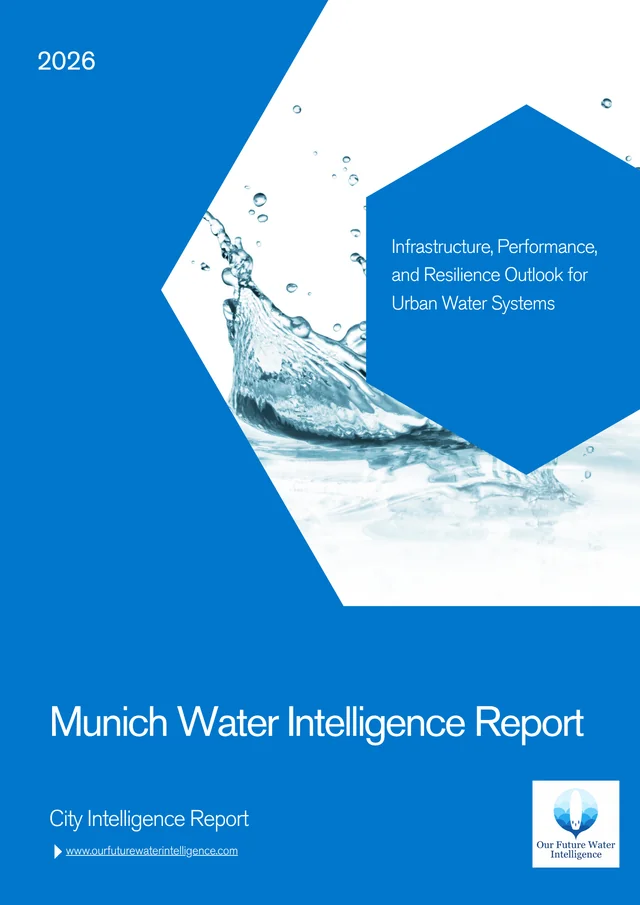
Munich Water Intelligence Report
- Format
- Digital report · PDF
- Length
- 38 pages
- Edition
- 2026
- Price
- USD 799
09
Report details
Publication details
- Publisher
- Our Future Water Intelligence
- Report family
- City Intelligence Report
- Report type
- City Water Intelligence
- Edition
- 2026
- Format
- Digital report · PDF
- Length
- 38 pages
- Reference
- OFW-8923602583730
12
Explore this report family
More City Water Intelligence reports
Explore the same report family covering other cities.
City Intelligence Report
Jeddah Water Intelligence Report
- Geography
- Jeddah, Saudi Arabia
- Edition
- November 2026, New edition
- Length
- 31 pages
Muscat Water Intelligence Report
- Geography
- Oman
- Edition
- November 2026, First edition
- Length
- 31 pages
City Water Intelligence
Dubai Water Intelligence Report
- Geography
- Dubai, United Arab Emirates
- Edition
- November 2026, New edition
- Length
- 32 pages