
01
Executive overview
Key findings
615 MIGD: DEWA's installed desalination capacity at 30 September 2026, against 495 MIGD a year earlier (actual); DEWA's target is 735 MIGD by end-2030 (target)
487 MIG: the 2025 daily peak in desalinated water demand, up from 455 MIG in 2024 (actual) and 8 MIGD below the 495 MIGD then installed (calculated)
AED 80 billion: the Dubai Strategic Sewerage Tunnels (DSST) programme, including long-term operating costs; preferred bidders chosen for two packages in June 2026, no formal award reported as of 24 November 2026
1.5 → 2.8 fils per gallon: Dubai Municipality's sewerage fee, 2025 to 2027 (approved schedule), a rise of 87% (calculated)
02
Buyer relevance
Who the report is for
Wastewater concession bidders and lenders
Track the Dubai Strategic Sewerage Tunnels, an AED 80 billion programme with preferred bidders for Packages J and W since June 2026 and Links bids due 19 November 2026, alongside the Jebel Ali sewage plant expansion.
Transmission and desalination contractors
Plan around Hassyan Phase 1's completion in Q1 2027, the 60 MIGD Phase 2 and the two Phase 2 transmission packages, whose lowest bids were AED 335.92 million and AED 792.6 million.
Drainage contractors and consultants
Size the Tasreef programme: AED 30 billion to 2033, with about AED 6.9 billion awarded in three rounds between April 2025 and October 2026.
Investors and analysts covering DEWA
Set DEWA's nine-month 2026 profit after tax of AED 7.63 billion and A3 rating against its water sales, network losses of 4.5% and the independent water producer model in which it holds 60%.
03
Decision scope
Questions answered
Is Dubai's desalination capacity keeping up with demand?
Capacity reached 615 MIGD at 30 September 2026, about 21% above the 2025 peak of 487 MIG; in 2025 the peak had come within 8 MIGD of the 495 MIGD then installed.
How much water does Dubai hold in storage?
DEWA reported 882 million imperial gallons of reservoir storage in 2024, about 1.8 days of the 2025 peak day, with 1,152 MIG planned and a 6,000 MIG aquifer storage project in implementation.
What do customers pay for water and sewerage?
Water costs AED 7.70 to 10.12 per m³ by monthly band, plus a fuel surcharge of AED 1.10 per m³ (September 2026); the sewerage fee is 2 fils per gallon in 2026 and 2.8 fils in 2027.
Where do the big wastewater and drainage projects stand?
The sewerage tunnel packages J and W had preferred bidders but no formal award as of 24 November 2026; Tasreef has three contract rounds awarded, worth about AED 6.9 billion of its AED 30 billion estimate.
How much water does Dubai's system supply per resident?
System demand of 161.505 billion imperial gallons in 2025 equals about 439 litres per resident per day across all uses and losses, or about 315 litres per person present at peak daytime.
04
Inside the report
Inside the complete report
Executive Snapshot
1. Introduction and City Water Context
2. Water Demand and Consumption
3. Water Infrastructure and Supply Systems
4. Utility Performance, Finance, and Customer Services
5. Governance, Regulation, and Digital Transformation
6. Climate Resilience and Sustainability
7. Strategic Outlook and Recommendations
Source Register
05
Public preview
What to watch next
1. Introduction and City Water Context
The next Digital Dubai population release; DEWA's FY2026 results in early 2027, the first annual results with Hassyan capacity in service.
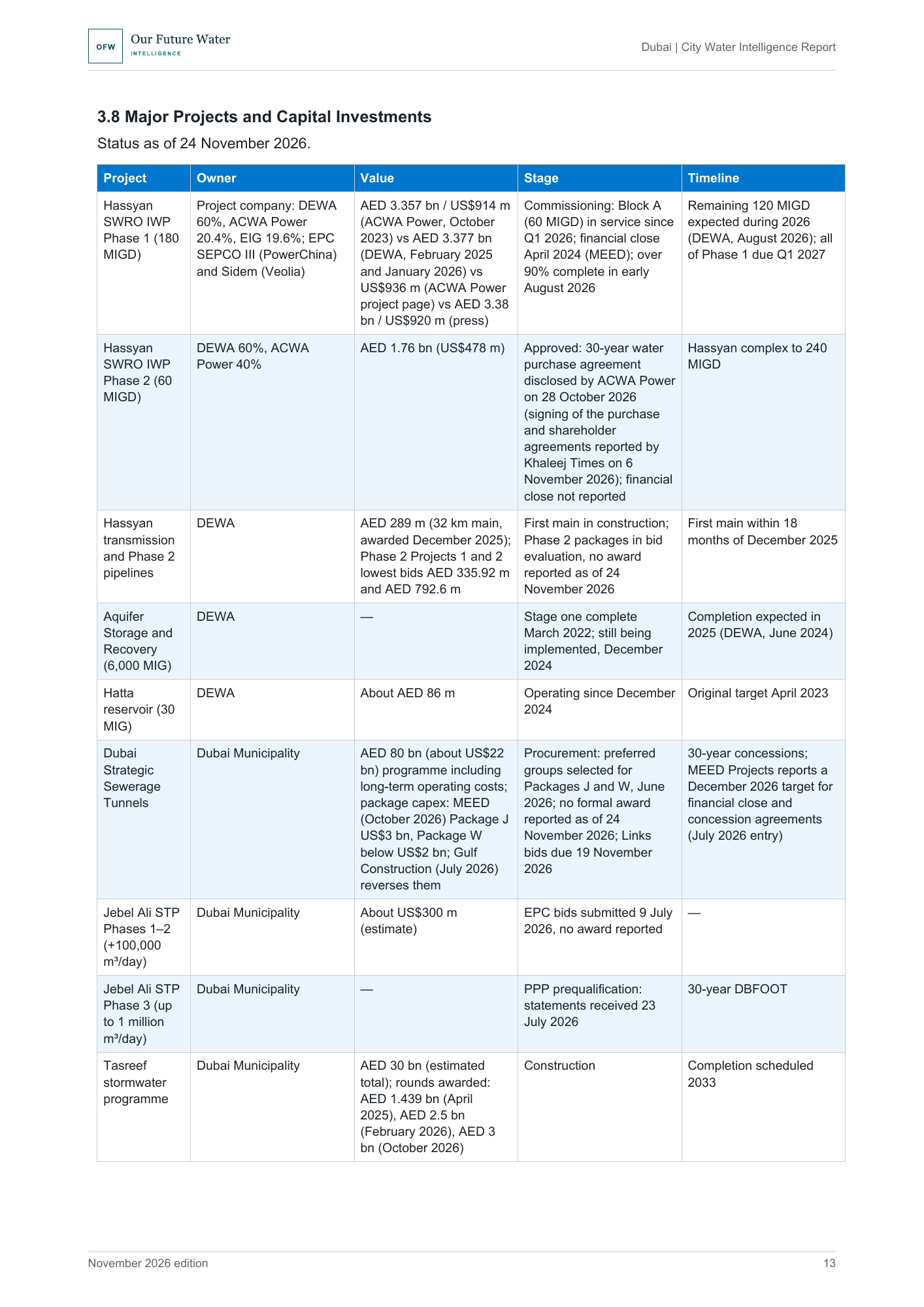
3.8 Major Projects and Capital Investments
Formal DSST awards for Packages J and W and financial close; the outcome of the Links bids due 19 November 2026; the Jebel Ali Phases 1–2 EPC award and the Phase 3 shortlist; awards of the two Hassyan Phase 2 pipeline packages; completion of Hassyan Phase 1.
4.8 Capital Investment Programmes and Financing Requirements
DEWA's FY2026 results (capacity, demand, losses and water sales); the monthly fuel surcharge; confirmation of the 2027 sewerage fee step; any decree or resolution setting the DSST payment mechanism; any rating action after May 2024.
6.8 Energy-Water Nexus Considerations
Further Tasreef rounds and Deira against end-2027; completion of the aquifer storage project; a DEWA statement on progress towards clean-energy desalination; reconciliation of the 50% and 30% city targets.
Major projects and capital investments, with owner, value, stage as of 24 November 2026 and timeline, from Section 3, Water Infrastructure and Supply Systems.
06
Included
What you receive
The complete PDF report: 32 pages, 9 sections, 45 tables and a register of 48 sources.
This edition
November 2026, New edition.
07
Evidence & method
Evidence and method
The report draws on DEWA's FY2025 and nine-month 2026 results, its 2024 Integrated Report and Q1 2025 interim financial statements, Dubai legislation and the published tariff and sewerage fee schedules, and official population and economic statistics. It adds Dubai Municipality and Government of Dubai Media Office project releases, developer disclosures and trade-press procurement reporting, and national climate and water strategies, with project and procurement status re-checked on 24 November 2026.
Sources
48 sources, listed in the report's source register. Evidence current to 24 November 2026. Principal data periods: DEWA FY2025 results and nine-month 2026 results (to 30 September 2026); population at end-2025; DEWA Integrated Report 2024; tariffs as published on DEWA's tariff page (last updated 16 May 2026); project, procurement and policy status re-checked on 24 November 2026. Currency: UAE dirham (AED); US dollars (US$) where sources report them. Water volumes in imperial gallons, as DEWA reports them (1 MIG = 4,546 m³, calculated from DEWA's 490 MIGD = 2,227,587 m³/day).
Evidence boundaries
This report uses authoritative source material available at the stated research cutoff. It distinguishes published facts, calculated values and analytical interpretation. No independent modelling is performed. Forward-looking analysis reflects published plans, documented trends and stated uncertainties. It does not constitute legal, financial, investment or engineering advice.
08
Lead analyst
Robert C. Brears
Lead Analyst, Our Future Water Intelligence
Robert C. Brears is a water-security specialist and author whose work examines utility transformation, infrastructure, governance, finance and climate resilience for executive and policy audiences.
- Evidence-led water intelligence
- Decision-focused system analysis
- Report-specific treatment of scope and terminology
09
Buyer FAQs
Before you purchase
Who can use the report?
Licensed for internal use within one purchasing organization. The PDF and its contents may be shared with colleagues within that organization. External redistribution, resale and public publication are prohibited without permission.
How is the report delivered?
The PDF is available to download immediately after confirmed payment, through our secure delivery system.
Can my organization buy wider access?
Institutional purchasing: For invoice enquiries, multi-organization licensing or broader access requirements, contact Our Future Water Intelligence.
10
Dubai Water Intelligence Report
- Format
- Length
- 32 pages
- Edition
- November 2026, New edition
- Price
- USD 799
11
Report details
Publication details
- Publisher
- Our Future Water Intelligence
- Report family
- City Intelligence Report
- Report type
- City Water Intelligence
- Edition
- November 2026, New edition
- Format
- Length
- 32 pages
- Reference
- OFW-8932233216178_7af6950cf7b8
- Evidence current to
- 24 November 2026
14
Explore this report family
More City Water Intelligence reports
Explore the same report family covering other cities.
City Intelligence Report
Jeddah Water Intelligence Report
- Geography
- Jeddah, Saudi Arabia
- Edition
- November 2026, New edition
- Length
- 31 pages
Muscat Water Intelligence Report
- Geography
- Oman
- Edition
- November 2026, First edition
- Length
- 31 pages
City Water Intelligence
Abu Dhabi Water Intelligence Report
- Geography
- Abu Dhabi, United Arab Emirates
- Edition
- November 2026, New edition
- Length
- 30 pages