
01
Executive overview
Key findings
11%: HOFOR's annual supply buffer in 2025, against a desired 20-30%
12 million m³ a year: drinking water shortfall HOFOR projects for Greater Copenhagen by 2040 without further action (forecast, as reported)
DKK 54.93 per m³: combined 2026 water and wastewater price including taxes and VAT, as stated at municipal approval, 13% above 2025 (HOFOR's price page gives DKK 49.57)
DKK 26.5 to 27.1 billion: estimated cost (2025 prices) of rebuilding metropolitan wastewater treatment, with a principle decision due on 13 November 2026
02
Buyer relevance
Who the report is for
Consultants and advisers new to the Danish water sector
See in one place how HOFOR, BIOFOS, the City of Copenhagen and Vandsektortilsynet divide ownership, operation and tariff control.
Treatment, tunnelling and construction suppliers
Use the project table, from the Regnemark waterworks due to supply from 2028 to the Valby cloudburst tunnel, framed at under DKK 1.1 billion, to see owners, values and stages.
Analysts following Nordic municipal utilities
Set the 2026 economic frameworks and HOFOR's DKK 1,595 million of 2025 investment in Copenhagen against the 41% rise in the water price component.
City and regional planners
Weigh HOFOR's 12 million m³ projected shortfall by 2040 against population projections of up to about 780,000 residents by 2060.
03
Decision scope
Questions answered
Where does Copenhagen's drinking water come from?
Only from groundwater, abstracted from wellfields across eastern and central Zealand and treated at seven regional waterworks; HOFOR's water business produced 54.1 million m³ in 2025, of which 31.6 million m³ was delivered in Copenhagen.
Is Copenhagen's water supply under pressure?
HOFOR's supply buffer was 11% in 2025 against a desired 20-30%, contamination has reduced output at 8 of about 50 wellfields, and HOFOR projects a 12 million m³ annual shortfall by 2040 without further action.
What does water cost in Copenhagen in 2026?
The city's approval papers give a combined price of DKK 54.93 per m³ including taxes and VAT, 13% above 2025, while HOFOR's price page gives DKK 49.57; the report shows both.
What is the largest decision coming up?
The BIOFOS board's principle decision on 13 November 2026 between rebuilding Lynetten in place (DKK 27.1 billion) and a new plant at Prøvestenen (DKK 26.5 billion), both 2025-price estimates.
04
Inside the report
Inside the complete report
Executive Snapshot
1. City Water Profile
2. Water Resources and Supply
3. Institutions and Utilities
4. Infrastructure and Major Projects
5. Tariffs and Finance
6. Climate and Resilience
7. Outlook and What to Watch
Source Register
05
Public preview
What to watch next
2. Water Resources and Supply
HOFOR's 2026 supply buffer in its next annual report; whether the 2026 demand peak recurs; findings from Water 2050.
4. Infrastructure and Major Projects
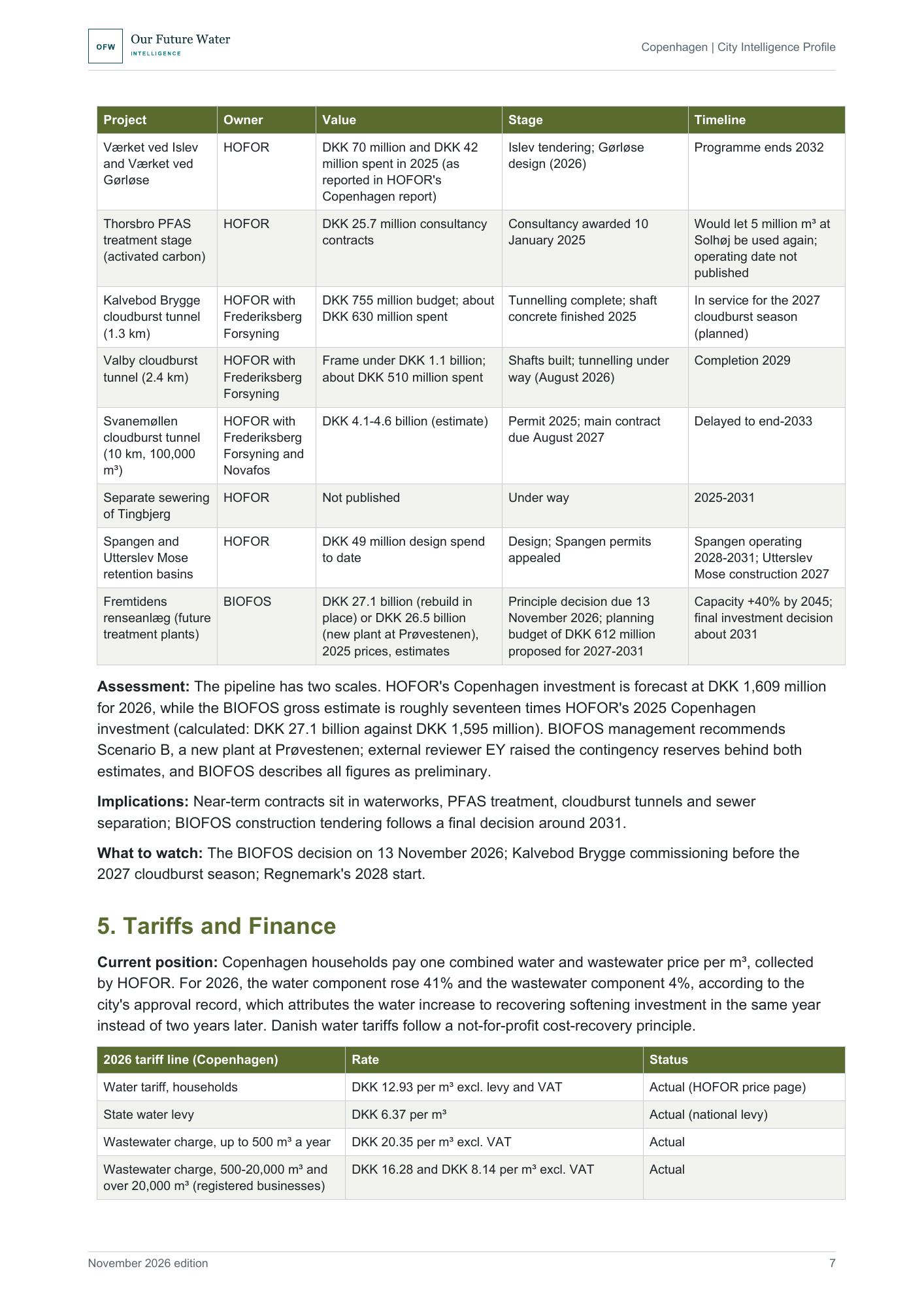
The BIOFOS decision on 13 November 2026; Kalvebod Brygge commissioning before the 2027 cloudburst season; Regnemark's 2028 start.
5. Tariffs and Finance
HOFOR's 2027 tariffs (the boards fixed the 2026 tariffs on 3 December 2025); the city's subsequent legality approval.
6. Climate and Resilience
The Folketing vote on the transitional extension; the draft climate adaptation strategy, which the city expected to present in October 2026 but which was not on the committee's October 2026 agendas.
Section 4: the major projects table, with owner, value, stage and timeline for waterworks, PFAS treatment, cloudburst tunnels and wastewater treatment.
06
Included
What you receive
The complete PDF report: 12 pages, 9 sections, 13 tables and a register of 20 sources.
This edition
November 2026, First edition.
07
Evidence & method
Evidence and method
The report draws on HOFOR's 2025 annual report and its Copenhagen companion report, Vandsektortilsynet's 2026 economic framework decisions, City of Copenhagen committee papers on tariffs, ownership and climate adaptation, BIOFOS's decision basis for its future treatment plants, Statistics Denmark population data and DMI climate projections.
Sources
20 sources, listed in the report's source register. Evidence current to 3 November 2026. Principal data periods: population at 1 January 2026; water and wastewater operations and accounts for 2025; tariffs for 2026; capital programme figures published in 2025 and 2026; climate projections published 2023 and 2024. All currency is Danish kroner (DKK) unless stated in euros (EUR)..
Evidence boundaries
This report uses authoritative source material available at the stated research cutoff. It distinguishes published facts, calculated values and analytical interpretation. No independent modelling is performed. Forward-looking analysis reflects published plans, documented trends and stated uncertainties. It does not constitute legal, financial, investment or engineering advice.
08
Lead analyst
Robert C. Brears
Founder, Our Future Water Intelligence
Robert C. Brears is a water-security specialist and author whose work examines utility governance, infrastructure investment, climate resilience and long-term water-system change for executive and policy audiences.
- Decision-focused utility intelligence
- Published water-policy author
- Evidence-grounded system analysis
09
Buyer FAQs
Before you purchase
Who can use the report?
Licensed for internal use within one purchasing organization. The PDF and its contents may be shared with colleagues within that organization. External redistribution, resale and public publication are prohibited without permission.
How is the report delivered?
The PDF is available to download immediately after confirmed payment, through our secure delivery system.
Can my organization buy wider access?
Institutional purchasing: For invoice enquiries, multi-organization licensing or broader access requirements, contact Our Future Water Intelligence.
10
Copenhagen City Intelligence Profile
- Format
- Length
- 12 pages
- Edition
- November 2026, First edition
- Price
- USD 99
11
Report details
Publication details
- Publisher
- Our Future Water Intelligence
- Report family
- City Intelligence Profile
- Edition
- November 2026, First edition
- Format
- Length
- 12 pages
- Reference
- OFW_EXT_COPENHAGEN_CITY_INTELLIGENCE_PROFILE_125d490fc99d
- Evidence current to
- 3 November 2026
14
Explore this report family
More City Intelligence Profiles
Explore the same report family covering other cities.
Muscat City Intelligence Profile
- Geography
- Oman
- Edition
- November 2026, New edition
- Length
- 13 pages
Jeddah City Intelligence Profile
- Geography
- Saudi Arabia
- Edition
- November 2026, First edition
- Length
- 13 pages
Doha City Intelligence Profile
- Geography
- Qatar
- Edition
- November 2026, First edition
- Length
- 13 pages