01
Executive overview
Key findings
346.9 million m3 a year: the City's licensed allocation from the Western Cape Water Supply System, which it expects to reach "within the next two years" (official statement, June 2026)
305 Ml/day: peak new supply in the New Water Programme by December 2036, of which 180 Ml/day (59%, calculated) depends on national partners or private partnerships (plan)
R6.7 billion: funding shortfall on the R14.7 billion, 10-year demand management strategy (estimate, 2025/26–2034/35)
65.2%: share of gross water receivables impaired at 30 June 2024, up from 26.7% a year earlier (audited)
02
Buyer relevance
Who the report is for
Investors, lenders and development finance institutions
Segment results, capital spend, receivables, the Moody's rating and the World Bank programme, with what each means for Cape Town's capacity to deliver.
Engineering firms, technology suppliers and partnership bidders
Every New Water Programme component with owner, stage and date, the Faure reuse procurement timetable, metering and wastewater upgrades.
Government, regulators and policy advisers
The institutional changes of 2026, the Water Services Amendment Bill, Green Drop performance and recommendations addressed to each level of government.
Strategy teams at utilities and advisory firms
A full reference on a city that lived through the 2015-2018 drought, with its demand management, tariff design and supply diversification set out in tables.
03
Decision scope
Questions answered
How exposed is Cape Town before new supply arrives?
The report sets out the City's planning basis to 2036, including the 1:50-year assurance of supply it accepts until about 2030 against its 1:200-year standard, and tests it against 5% demand growth in 2025/26.
Which projects are open to partners, and when?
The Faure reuse partnership (70 Ml/day, about R3.2 billion estimate) is in procurement, with qualification submissions due 26 February 2027 and proposals in the second half of 2027. Desalination (about R5 billion, 2023 base) awaits a new site.
How strong are the water finances?
In 2023/24 water made a R1.73 billion surplus on R6.03 billion of revenue while wastewater broke even, 74.42% of the capital budget was spent and water receivables impairment reached 65.2%. The City is rated Ba2 with a positive outlook.
What should decision-makers prioritise?
The report ranks five investment priorities by timing, from closing the R6.7 billion demand strategy gap to securing a desalination site, and makes recommendations to the City, national government, regulators, investors and development institutions.
04
Inside the report
Inside the complete report
Executive Snapshot
1. Introduction and City Water Context
2. Water Demand and Consumption
3. Water Infrastructure and Supply Systems
4. Utility Performance, Finance, and Customer Services
5. Governance, Regulation, and Digital Transformation
6. Climate Resilience and Sustainability
7. Strategic Outlook and Recommendations
Source Register
05
Public preview
What to watch next
3.1 Source Water Systems
The 2 November 2026 annual operating analysis; groundwater output on the weekly dashboard.
3.6 Water Reuse and Circular Water Systems
The number of consortia qualifying after 26 February 2027; the request for proposals in the second half of 2027.
3.8 Major Projects and Capital Investments
The desalination site decision; Berg River tender and construction preparations; funding approval for the Infrastructure Stability Programme.
4.2 Tariff Structures
2027/28 tariff proposals in the draft budget; whether restriction tariffs are activated this summer.
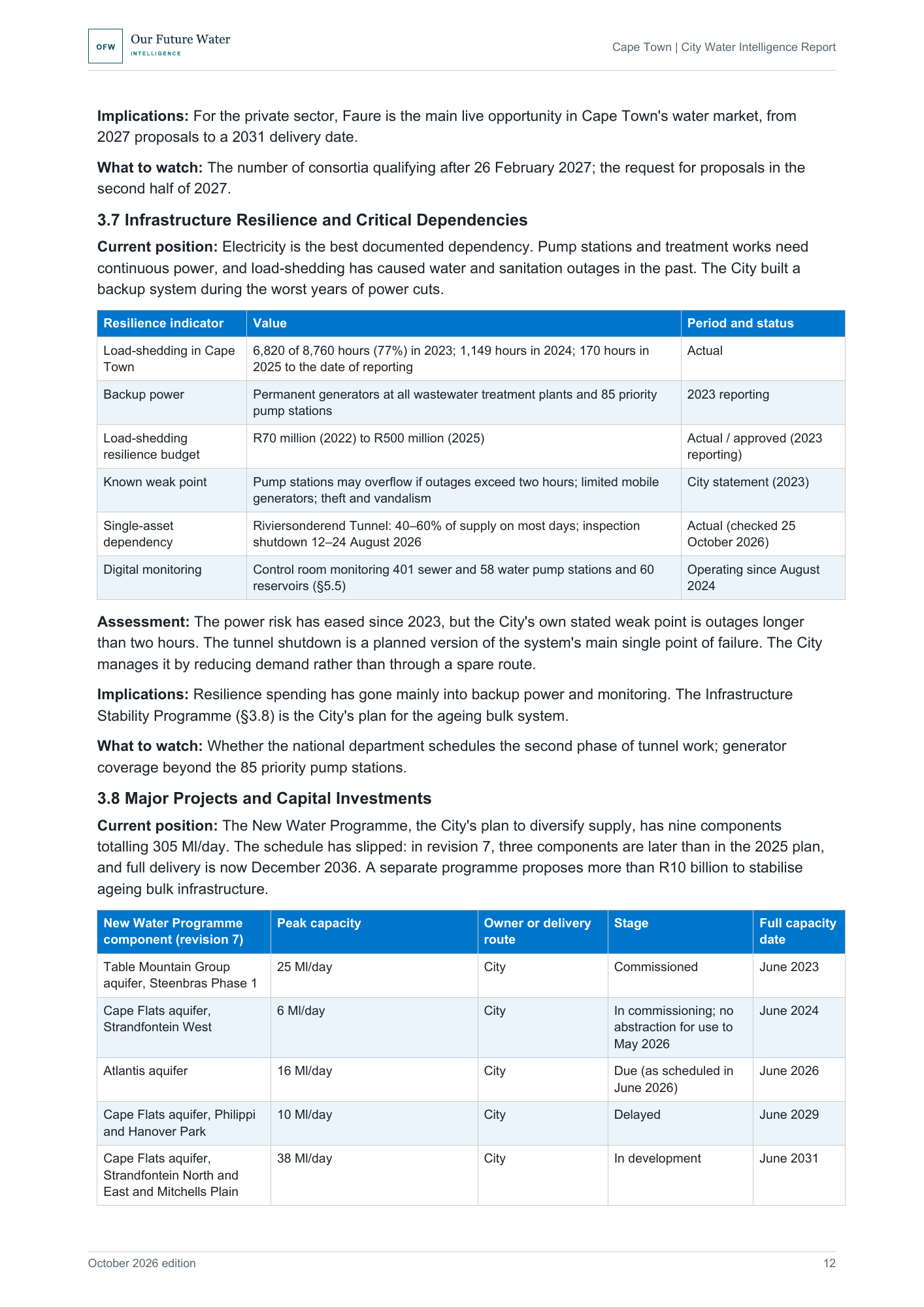
Infrastructure resilience indicators, then Major Projects and Capital Investments: the New Water Programme components with capacity, delivery route, stage and dates.
06
Included
What you receive
The complete PDF report: 33 pages, 9 sections, 49 tables and a register of 45 sources.
This edition
October 2026, Second edition. Audited 2023/24 financial statements, the 2024/25 integrated annual report and Census 2022. The June 2026 Water Outlook, 2026/27 tariffs and the weekly dashboard to 5 October 2026, when the City moved to Drought Response. Revision 7 of the New Water Programme, the Faure reuse procurement launched on 25 September 2026 and the uncertainty over the desalination site. Moody's positive outlook (26 May 2026), the World Bank metro programme approved in November 2025 and the R2.5 billion Cape Water Performance-Based Bond. New edition, October 2026, with evidence current to 25 October 2026. Replaces the earlier edition for new buyers; buyers of an earlier edition keep access to the edition they bought.
07
Evidence & method
Evidence and method
Built on the City of Cape Town's Water Outlook, weekly water dashboards, audited financial statements, integrated annual report, budget and tariff schedules, water strategy and development plan, with Moody's, OECD, World Bank and Parliament sources and news and trade reporting checked on 25 October 2026.
Sources
45 sources, listed in the report's source register. Evidence current to 25 October 2026. Principal data periods: Census 2022; 2023/24 audited financial statements; 2024/25 Integrated Annual Report; Cape Town Water Outlook, June 2026; 2026/27 tariffs; weekly water dashboard to 5 October 2026, with web checks to 25 October 2026. Currency is South African rand (R) unless stated..
Evidence boundaries
This report uses authoritative source material available at the stated research cutoff. It distinguishes published facts, calculated values and analytical interpretation. No independent modelling is performed. Forward-looking analysis reflects published plans, documented trends and stated uncertainties. It does not constitute legal, financial, investment or engineering advice.
08
Lead analyst
Robert C. Brears
Founder, Our Future Water Intelligence
Robert C. Brears is a water-security specialist and author whose work examines utility governance, infrastructure investment, climate resilience and long-term water-system change for executive and policy audiences.
- Decision-focused utility intelligence
- Published water-policy author
- Evidence-grounded system analysis
09
Buyer FAQs
Before you purchase
Who can use the report?
Licensed for internal use within one purchasing organization. The PDF and its contents may be shared with colleagues within that organization. External redistribution, resale and public publication are prohibited without permission.
How is the report delivered?
The PDF is available to download immediately after confirmed payment, through our secure delivery system.
Can my organization buy wider access?
Institutional purchasing: For invoice enquiries, multi-organization licensing or broader access requirements, contact Our Future Water Intelligence.
10
Cape Town Water Intelligence Report
- Format
- Length
- 33 pages
- Edition
- October 2026, Second edition
- Price
- USD 799
11
Report details
Publication details
- Publisher
- Our Future Water Intelligence
- Report family
- City Intelligence Report
- Report type
- City Water Intelligence
- Edition
- October 2026, Second edition
- Format
- Length
- 33 pages
- Reference
- OFW-CITY-CAPE-TOWN-2026_d29f07173280
- Evidence current to
- 25 October 2026
14
Explore this report family
More City Water Intelligence reports
Explore the same report family covering other cities.
City Intelligence Report
Jeddah Water Intelligence Report
- Geography
- Jeddah, Saudi Arabia
- Edition
- November 2026, New edition
- Length
- 31 pages
Muscat Water Intelligence Report
- Geography
- Oman
- Edition
- November 2026, First edition
- Length
- 31 pages
City Water Intelligence
Dubai Water Intelligence Report
- Geography
- Dubai, United Arab Emirates
- Edition
- November 2026, New edition
- Length
- 32 pages