
01
Executive overview
Key findings
A$7,307.7 million: capital expenditure benchmark adopted by the Essential Services Commission for 2026–2031 (final decision, 5 June 2026), against A$7.9 billion proposed
150 GL: desalinated water ordered for 2026-27, the plant's maximum ordering level
204,379 t CO2-e: net Scope 1 and 2 emissions in 2024-25 after carbon credits, 50% below baseline; gross emissions were 395,916 t CO2-e
A$711 million: Western Treatment Plant Resource Recovery and Re-Use Complex, planned to be fully operational in 2029
02
Buyer relevance
Who the report is for
Treatment, tunneling and dam contractors
Map the Western Trunk Sewer, Maroondah outlet, Cardinia Dam and treatment plant projects against their published costs and schedules to 2030.
Energy and decarbonization providers
Size the gap between gross emissions of 395,916 t CO2-e in 2024-25 and the 2030 net-zero target.
Digital and control-system vendors
Judge where Melbourne Water's monitoring, digital twin and SCADA programs sit between pilot and operating stage.
Investors and state policy advisers
Read the FY2021–FY2025 financial series and the 2026–2031 regulatory settlement alongside the state's pending supply decisions.
03
Decision scope
Questions answered
How much capital spending did the regulator allow for 2026–2031?
The Essential Services Commission adopted a benchmark of A$7,307.7 million, against A$7.9 billion proposed by Melbourne Water.
Has Melbourne Water halved its emissions?
Net emissions of 204,379 t CO2-e in 2024-25 were 50% below the baseline, but gross emissions of 395,916 t CO2-e were only about 3% below it.
How much desalinated water has been ordered?
The 2026-27 order is 150 GL, the plant's maximum ordering level, with deliveries brought forward to June 2026.
How have Melbourne Water's finances changed?
Between FY2021 and FY2025, revenue rose 6.1% while operating and other expenses rose 24.2%, and net profit after tax fell 57.4%.
04
Inside the report
Inside the complete report
Executive Snapshot
1. From Service Provider to System Operator
2. System Intelligence and Digital Control
3. Energy, Carbon, and Resource Decoupling
4. Infrastructure Strategy for a Non-Stationary Climate
5. Customers, Demand, and the Water Prosumer
6. Governance, Regulation, and Institutional Reform
7. Capital Planning and Financial Architecture
8. Workforce, Capability, and Organisational Change
9. Strategic System Roadmap
Conclusion
Source Register
05
Public preview
What to watch next
7. Capital Planning and Financial Architecture
FY2026 results, especially net profit and borrowings; gearing as the capital program ramps up; the annual price adjustments the ESC approves within the 2026–2031 period.
4. Infrastructure Strategy for a Non-Stationary Climate
Storage levels and any restrictions over summer 2026/27; the following year's desalination order; the Water Security Taskforce report due in March 2027; completion of the Hobsons Bay Main Sewer.
6. Governance, Regulation, and Institutional Reform
The Water Security Taskforce report due in March 2027 and the government's response; Melbourne Water's implementation of the five drainage audit recommendations, including public reporting of growth-area performance; any further statement on future ownership options.
9. Strategic System Roadmap
The 2025-26 annual report; the state's choice of the next supply source; delivery milestones on the trunk sewers and the Western Treatment Plant complex.
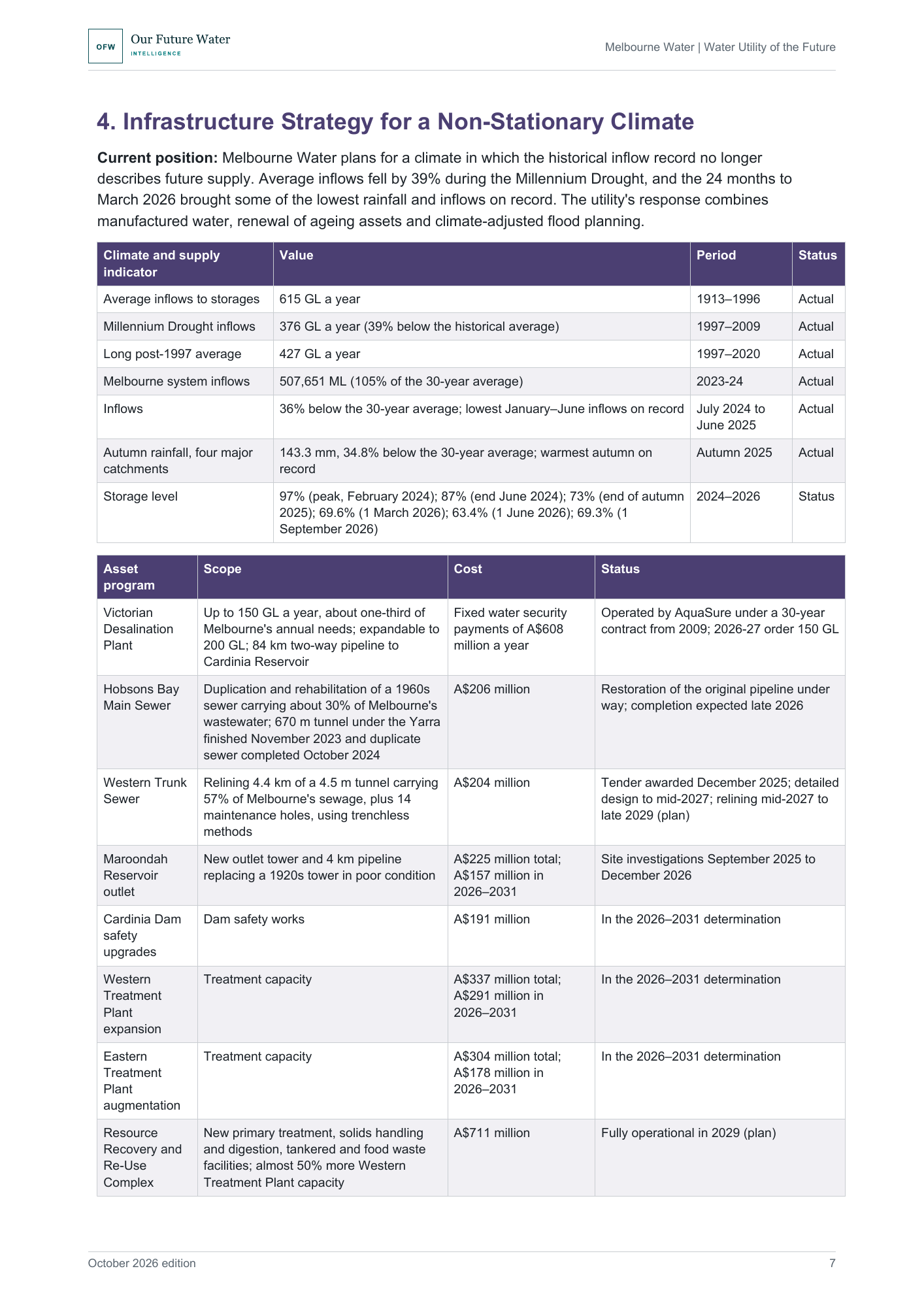
Section 4 sets inflows, storage levels and the major asset programs side by side, with cost and status for each.
06
Included
What you receive
The complete PDF report: 16 pages, 12 sections, 17 tables and a register of 34 sources.
This edition
October 2026 edition.
07
Evidence & method
Evidence and method
The report draws on Melbourne Water annual reports from 2016-17 to 2024-25, Essential Services Commission price decisions for 2016, 2021 and 2026, and Melbourne Water's water supply, sewerage, flood, energy and project publications. Current status is checked against state government releases, Victorian Auditor-General's Office audits, the 2026 Water Outlook and parliamentary proceedings.
Sources
34 sources, listed in the report's source register. Evidence current to 29 October 2026. Principal data periods: FY2025 audited results (year ended 30 June 2025); 2026–2031 regulatory period (Essential Services Commission final decision, 5 June 2026); storage and desalination status to 1 September 2026. Status checked against public sources on 29 October 2026. All currency is Australian dollars (A$)..
Evidence boundaries
This report uses authoritative source material available at the stated research cutoff. It distinguishes published facts, calculated values and analytical interpretation. No independent modelling is performed. Forward-looking analysis reflects published plans, documented trends and stated uncertainties. It does not constitute legal, financial, investment or engineering advice.
08
Lead analyst
Robert C. Brears
Founder, Our Future Water Intelligence
Robert C. Brears is a water-security specialist and author whose work examines utility governance, infrastructure investment, climate resilience and long-term water-system change for executive and policy audiences.
- Decision-focused utility intelligence
- Published water-policy author
- Evidence-grounded system analysis
09
Buyer FAQs
Before you purchase
Who can use the report?
Licensed for internal use within one purchasing organization. The PDF and its contents may be shared with colleagues within that organization. External redistribution, resale and public publication are prohibited without permission.
How is the report delivered?
The PDF is available to download immediately after confirmed payment, through our secure delivery system.
Can my organization buy wider access?
Institutional purchasing: For invoice enquiries, multi-organization licensing or broader access requirements, contact Our Future Water Intelligence.
10
Water Utility of the Future: Melbourne Water
- Format
- Length
- 16 pages
- Edition
- October 2026 edition
- Price
- USD 499
11
Report details
Publication details
- Publisher
- Our Future Water Intelligence
- Report family
- Water Utility Intelligence Report
- Edition
- October 2026 edition
- Format
- Length
- 16 pages
- Reference
- OFW_EXT_WATER_UTILITY_OF_THE_FUTURE_MELBOURNE_WATER_7d6e1e0ed8e9
- Evidence current to
- 29 October 2026
14
Explore this report family
More Water Utility of the Future reports
Explore the same report family covering other utilities.
Water Utility of the Future
Water Utility of the Future: Department of Energy, Abu Dhabi Emirate
- Geography
- Abu Dhabi, United Arab Emirates
- Edition
- November 2026, New edition
- Length
- 16 pages
Water Utility of the Future
Water Utility of the Future: Water and Sanitation Directorate, City of Cape Town
- Geography
- Cape Town, South Africa
- Edition
- November 2026, New edition
- Length
- 14 pages
Water Utility of the Future
Water Utility of the Future: Electricity and Water Authority
- Geography
- Bahrain, Middle East
- Edition
- November 2026, New edition
- Length
- 15 pages