
01
Executive overview
Key findings
About US$2.1 billion: Metropolitan Water Tunnel Program estimate; both tunnels operational by 2040 (target; final cost "not yet defined")
US$226.8 million: FY2026 actual capital spending, about 40% below the US$380.3 million budget
About US$1.3 billion: draft Updated CSO Control Plan, designed for zero CSO discharges to the Charles, Mystic and Alewife Brook in a projected 2050 typical rainfall year (draft)
55.3%: share of the FY2026 Current Expense Budget for capital financing (budgeted)
02
Buyer relevance
Who the report is for
Engineering and construction firms in tunnels, wastewater and coastal works
Time bids around South Tunnel bidding in late 2027 and the US$70 million Deer Island Eastern Seawall award planned for FY2027.
Energy developers and equipment suppliers
Size the Deer Island opportunity from a 24.0% own-generation share in FY2025, a CHP projected at 69.3 GWh a year and a US$31 million battery study estimate.
Municipal bond analysts and investors
Weigh 186% and 187% primary coverage in FY2025 against FY2024–FY2028 cap spending forecast at about US$1.1 billion, about US$309 million under the US$1.4 billion cap.
Member community and state policy staff
Follow the draft overflow plan's US$340 million, US$260 million and US$690 million river shares and the lead program's 2032 goal.
03
Decision scope
Questions answered
How much is MWRA planning to spend on new water tunnels?
The Metropolitan Water Tunnel Program estimate is about US$2.1 billion, with both tunnels targeted to be operational by 2040; MWRA says the final cost is not yet defined.
Is MWRA spending its capital budget?
No. FY2026 capital spending was US$226.8 million, about 40% below the US$380.3 million budget; the FY2027 Final CIP is US$322.1 million.
How much of its own electricity does Deer Island produce?
In FY2025 Deer Island produced 34,814,562 kWh of its own electricity against 144,889,154 kWh required, a 24.0% share, down from 34.1% in FY2017.
What will the updated overflow plan cost?
The draft Updated CSO Control Plan is about US$1.3 billion in current dollars, designed for zero discharges in a projected 2050 typical rainfall year; the final plan is due in 2027.
04
Inside the report
Inside the complete report
Executive Snapshot
1. From Service Provider to System Operator
2. Energy, Carbon, and Resource Decoupling
3. Infrastructure Strategy for a Non-Stationary Climate
4. Customers, Demand, and the Water Prosumer
5. Governance, Regulation, and Institutional Reform
6. Capital Planning and Financial Architecture
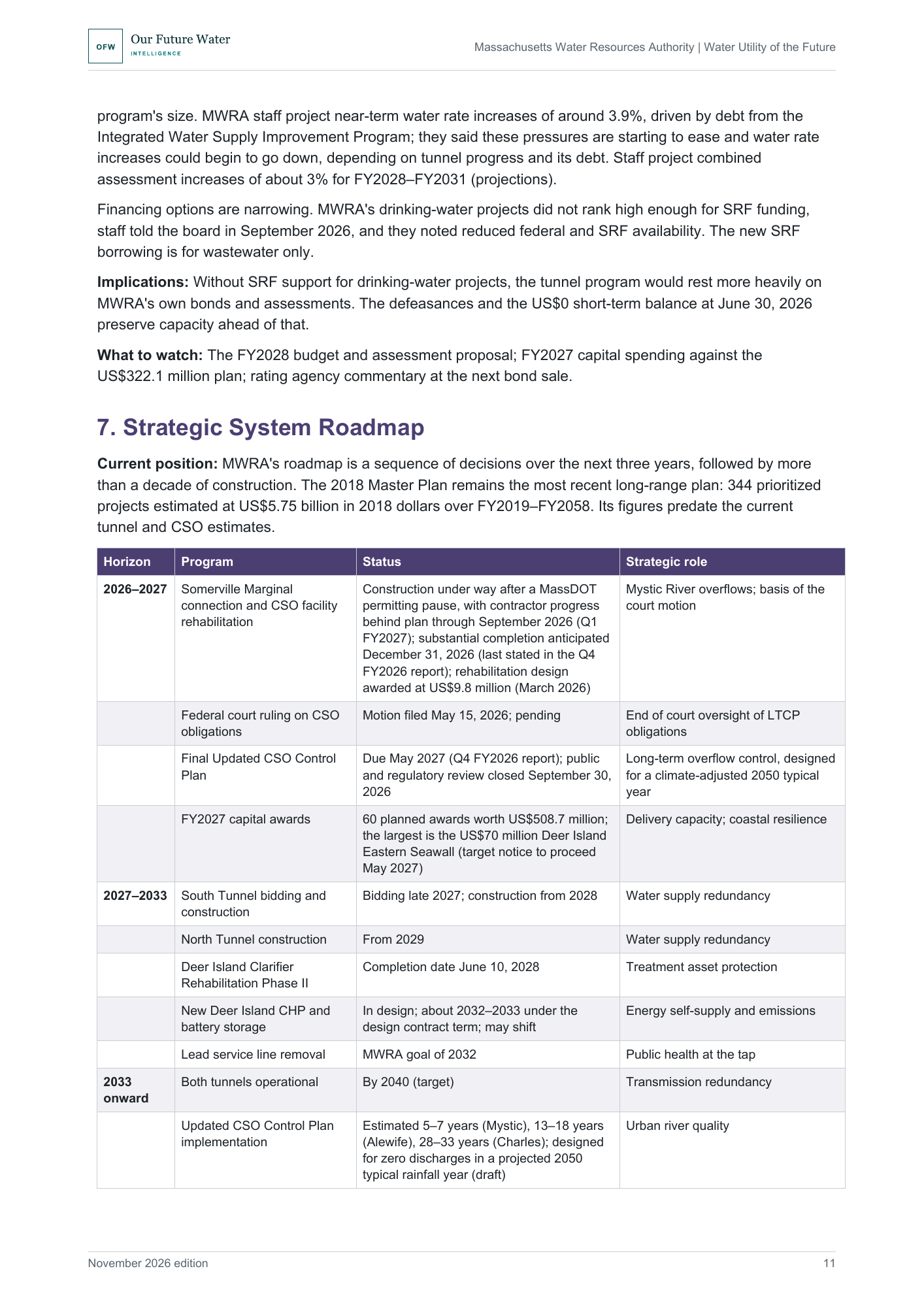
7. Strategic System Roadmap
Conclusion
Source Register
05
Public preview
What to watch next
6. Capital Planning and Financial Architecture
The FY2028 budget and assessment proposal; FY2027 capital spending against the US$322.1 million plan; rating agency commentary at the next bond sale.
7. Strategic System Roadmap
The FY2028–FY2033 capital prioritization; the final CSO plan's cost allocation among communities; South Tunnel procurement documents.
3. Infrastructure Strategy for a Non-Stationary Climate
South Tunnel bidding in late 2027; the Eastern Seawall award in FY2027; Quabbin volume at June 30, 2027.
5. Governance, Regulation, and Institutional Reform
Gulliver's start date; the court's ruling on MWRA's motion; issuance of the final Deer Island permit.
The Strategic System Roadmap, setting MWRA's overflow, tunnel, energy and lead programs against their milestones from 2026 onward.
06
Included
What you receive
The complete PDF report: 14 pages, 10 sections, 18 tables and a register of 26 sources.
This edition
November 2026, First edition.
07
Evidence & method
Evidence and method
The report draws on MWRA's FY2025 annual financial report, its 2026 bond Official Statement and rating agency reports, its FY2024 to FY2027 budgets and capital programs, quarterly performance indicators, the greenhouse gas inventory, and board papers and votes to October 21, 2026.
Sources
26 sources, listed in the report's source register. Evidence current to 9 November 2026. Principal data periods: FY2025 audited results (fiscal years end June 30; FY2025 is the year ended June 30, 2025); FY2026 and FY2027 budgets and capital program; board decisions to October 21, 2026; status checked to November 9, 2026. All currency is US dollars..
Evidence boundaries
This report uses authoritative source material available at the stated research cutoff. It distinguishes published facts, calculated values and analytical interpretation. No independent modelling is performed. Forward-looking analysis reflects published plans, documented trends and stated uncertainties. It does not constitute legal, financial, investment or engineering advice.
08
Lead analyst
Robert C. Brears
Founder, Our Future Water Intelligence
Robert C. Brears is a water-security specialist and author whose work examines utility governance, infrastructure investment, climate resilience and long-term water-system change for executive and policy audiences.
- Decision-focused utility intelligence
- Published water-policy author
- Evidence-grounded system analysis
09
Buyer FAQs
Before you purchase
Who can use the report?
Licensed for internal use within one purchasing organization. The PDF and its contents may be shared with colleagues within that organization. External redistribution, resale and public publication are prohibited without permission.
How is the report delivered?
The PDF is available to download immediately after confirmed payment, through our secure delivery system.
Can my organization buy wider access?
Institutional purchasing: For invoice enquiries, multi-organization licensing or broader access requirements, contact Our Future Water Intelligence.
10
Water Utility of the Future: Massachusetts Water Resources Authority
- Format
- Length
- 14 pages
- Edition
- November 2026, First edition
- Price
- USD 499
11
Report details
Publication details
- Publisher
- Our Future Water Intelligence
- Report family
- Water Utility Intelligence Report
- Edition
- November 2026, First edition
- Format
- Length
- 14 pages
- Reference
- OFW_EXT_WATER_UTILITY_OF_THE_FUTURE_MASSACHUSETTS_WATER_RESOURCES_AUTHORITY_b51d402dd9bf
- Evidence current to
- 9 November 2026
14
Explore this report family
More Water Utility of the Future reports
Explore the same report family covering other utilities.
Water Utility of the Future
Water Utility of the Future: Department of Energy, Abu Dhabi Emirate
- Geography
- Abu Dhabi, United Arab Emirates
- Edition
- November 2026, New edition
- Length
- 16 pages
Water Utility of the Future
Water Utility of the Future: Water and Sanitation Directorate, City of Cape Town
- Geography
- Cape Town, South Africa
- Edition
- November 2026, New edition
- Length
- 14 pages
Water Utility of the Future
Water Utility of the Future: Electricity and Water Authority
- Geography
- Bahrain, Middle East
- Edition
- November 2026, New edition
- Length
- 15 pages