01
Executive overview
Key findings
R13.06 billion: five-year capital budget for 2026/27–2030/31, from R1.96 billion in 2026/27 to R4.384 billion in 2030/31 (budgeted, Business Plan 2026/27)
44.79% → 29.54%: non-revenue water in FY2024/25 (actual) and the Circular 88 target for 2029/30 (target); the half-year figure for H1 2025/26 was 48.7%
1,801 → 1,550 Ml/d: City consumption in June 2024 (actual) and the reduction required under Rand Water's abstraction licence (target)
140 Ml: new reservoir capacity in a program of 44 reservoirs and towers, with five new towers (program, Executive Mayor, July 2026)
02
Buyer relevance
Who the report is for
Pipe, reservoir and pump-station contractors
Follow a capital budget that rises from R1.96 billion in 2026/27 to R4.384 billion in 2030/31, the 44-reservoir storage program and the late-payment delays on Hursthill 2 and Craigavon.
Leak detection, metering and pressure-management firms
Track the performance-based contract for five district metered areas carrying 22% of system input and the 479 of 714 pressure-reducing valves already rehabilitated.
Development finance institutions and lenders
Weigh the ZAR 750 million IFC proposal on 'Hold', the R13 billion sought for pipe replacement and a collection rate of 74.84% in FY2024/25.
Wastewater treatment and compliance advisers
Set a Green Drop average of 49% and effluent compliance of 70.9% against the City's 85% target for December 2026 and a bulk wastewater budget rising to R1.7 billion.
03
Decision scope
Questions answered
What changed for Johannesburg Water in July 2026?
Cash sweeping to the City stopped on June 30, 2026, and single-point accountability for water and sanitation took effect on July 1, 2026 under National Treasury's Metro Trading Services Reform.
How large is the capital plan, and is it being spent?
R13.06 billion over 2026/27 to 2030/31; the utility spent 101.64% of its FY2024/25 budget but only 18% of the R1.704 billion 2025/26 budget by December 31, 2025.
How far must demand fall?
From 1,801 Ml/d in June 2024 to the 1,550 Ml/d required under Rand Water's licence; Level 2 restrictions from November 21, 2026 aim to cut consumption by 200 million litres a day.
When does new bulk water arrive?
The Lesotho Highlands Water Project Phase II was 56.7% complete in September 2026, with impoundment from July 2027 and extra water expected about 2028.
04
Inside the report
Inside the complete report
Executive Snapshot
1. From Service Provider to System Operator
2. System Intelligence and Digital Control
3. Energy, Carbon, and Resource Decoupling
4. Infrastructure Strategy for a Non-Stationary Climate
5. Customers, Demand, and the Water Prosumer
6. Governance, Regulation, and Institutional Reform
7. Capital Planning and Financial Architecture
8. Workforce, Capability, and Organisational Change
9. Strategic System Roadmap
Conclusion
Source Register
05
Public preview
What to watch next
7. Capital Planning and Financial Architecture
The FY2025/26 capital outturn against the R1.704 billion budget; IFC status changing from "Hold"; signature of the pipe-replacement financing; the 2027/28 business plan's restated five-year total.
4. Infrastructure Strategy for a Non-Stationary Climate
Confirmation of Crosby and the B-line in December 2026; Hursthill 2 restarting; award of the 15-reservoir repair package; a completion date for Northern Works Unit 5 Module 2; Polihali impoundment in July 2027.
6. Governance, Regulation, and Institutional Reform
The effluent result for December 2026 against the 85% target; the next Green Drop audit; the outcome of the DWS proceedings; conditions attached to the first tranche of the reform grant.
2. System Intelligence and Digital Control
Award of the five-district contract and the name of the contractor; extension of district metering beyond the first 22% of input; billing on actual readings reaching the 92% target.
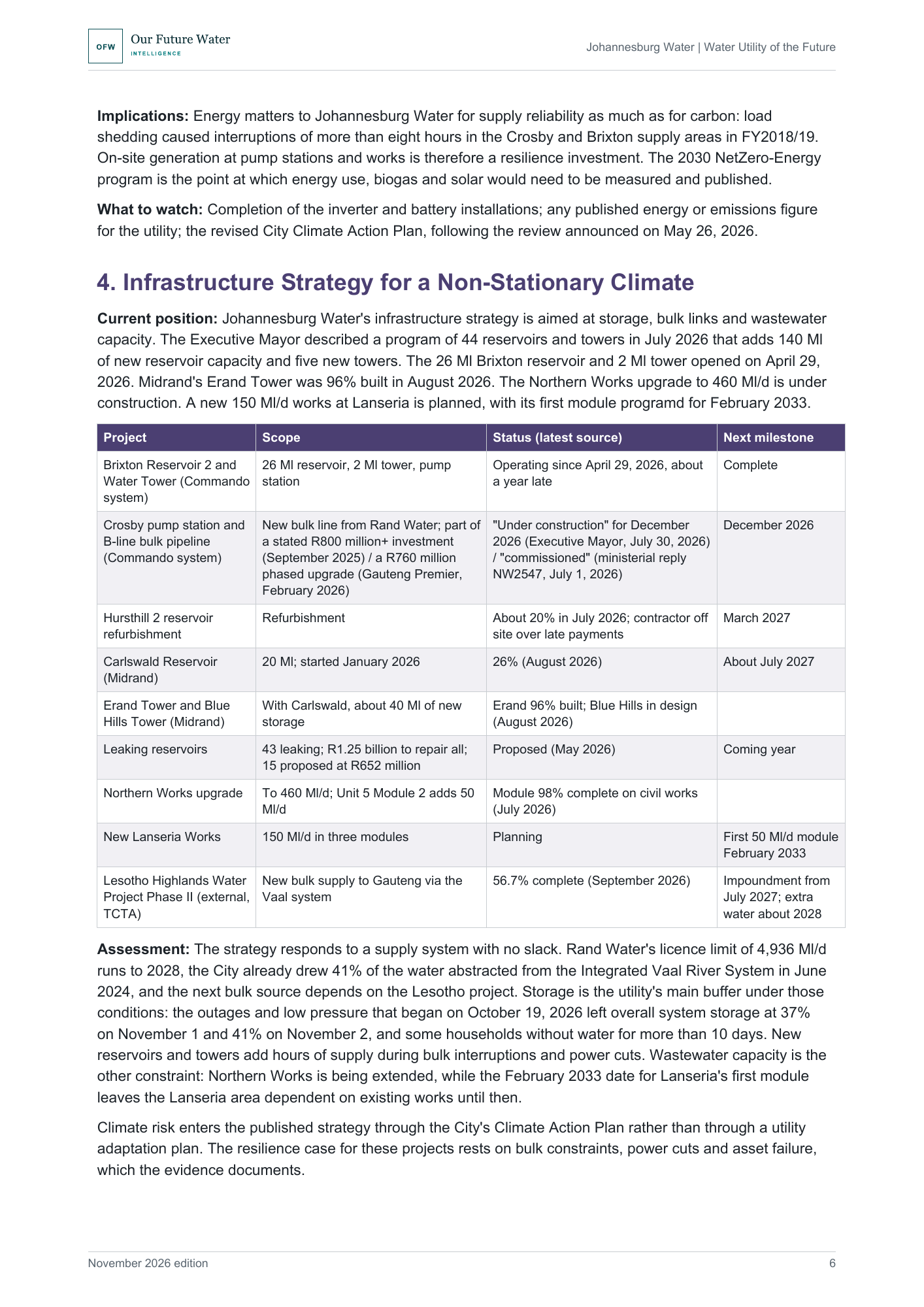
Section 4: Johannesburg Water's storage, bulk supply and wastewater projects, with status checked on November 23, 2026 and the next milestone for each.
06
Included
What you receive
The complete PDF report: 14 pages, 12 sections, 9 tables and a register of 29 sources.
This edition
November 2026, First edition.
07
Evidence & method
Evidence and method
Johannesburg Water's integrated annual reports to FY2024/25, its business plans to 2026/27 and its 2025/26 mid-year report. Project, funding, tariff, legal and supply status comes from City of Johannesburg statements, parliamentary replies, the IFC disclosure and press reports checked on November 23, 2026.
Sources
29 sources, listed in the report's source register. Evidence current to 23 November 2026. Principal data periods: FY2024/25 Integrated Annual Report (year ended June 30, 2025); mid-year report for H1 FY2025/26 (to December 31, 2025); Business Plan 2026/27; project, tariff, legal and supply status checked on November 23, 2026. Currency is South African rand (R); "R…k" is rand thousand, as printed by the utility.
Evidence boundaries
This report uses authoritative source material available at the stated research cutoff. It distinguishes published facts, calculated values and analytical interpretation. No independent modelling is performed. Forward-looking analysis reflects published plans, documented trends and stated uncertainties. It does not constitute legal, financial, investment or engineering advice.
08
Lead analyst
Robert C. Brears
Founder, Our Future Water Intelligence
Robert C. Brears is a water-security specialist and author whose work examines utility governance, infrastructure investment, climate resilience and long-term water-system change for executive and policy audiences.
- Decision-focused utility intelligence
- Published water-policy author
- Evidence-grounded system analysis
09
Buyer FAQs
Before you purchase
Who can use the report?
Licensed for internal use within one purchasing organization. The PDF and its contents may be shared with colleagues within that organization. External redistribution, resale and public publication are prohibited without permission.
How is the report delivered?
The PDF is available to download immediately after confirmed payment, through our secure delivery system.
Can my organization buy wider access?
Institutional purchasing: For invoice enquiries, multi-organization licensing or broader access requirements, contact Our Future Water Intelligence.
10
Water Utility of the Future: Johannesburg Water
- Format
- Length
- 14 pages
- Edition
- November 2026, First edition
- Price
- USD 499
11
Report details
Publication details
- Publisher
- Our Future Water Intelligence
- Report family
- Water Utility Intelligence Report
- Edition
- November 2026, First edition
- Format
- Length
- 14 pages
- Reference
- OFW_EXT_WATER_UTILITY_OF_THE_FUTURE_JOHANNESBURG_WATER_06acdc121fde
- Evidence current to
- 23 November 2026
14
Explore this report family
More Water Utility of the Future reports
Explore the same report family covering other utilities.
Water Utility of the Future
Water Utility of the Future: Department of Energy, Abu Dhabi Emirate
- Geography
- Abu Dhabi, United Arab Emirates
- Edition
- November 2026, New edition
- Length
- 16 pages
Water Utility of the Future
Water Utility of the Future: Water and Sanitation Directorate, City of Cape Town
- Geography
- Cape Town, South Africa
- Edition
- November 2026, New edition
- Length
- 14 pages
Water Utility of the Future
Water Utility of the Future: Electricity and Water Authority
- Geography
- Bahrain, Middle East
- Edition
- November 2026, New edition
- Length
- 15 pages