
01
Executive overview
Key findings
US$9.69 billion: ten-year capital disbursements, FY 2026–FY 2035, in the FY 2027 Approved Budget (adopted March 5, 2026)
US$819 million: Potomac River Tunnel, one of the two tunnels in the Clean Rivers final phase, with completion due in 2030
US$21 million: committed over three years (2025–2028) to Pure Water DC, a study and pilot program for a second drinking water source
More than 12,000: lead service lines replaced by summer 2026, against an original 2030 target for removing all lead lines in the District; DC Water says completion will extend beyond 2030
02
Buyer relevance
Who the report is for
Utility board members and executives
Compare DC Water's dated 2027–2030 commitments, from the Discovery Center to the Potomac River Tunnel, with their own transition roadmap.
Municipal bond investors and credit analysts
Set the planned US$3.9 billion of new debt and the projected rise to US$6.9 billion by FY 2035 against FY 2025 coverage of 2.40x and the February 2026 ratings.
Engineering, tunneling and water reuse firms
Track where DC Water's program stands: tunnels under construction, Potomac Interceptor rehabilitation brought forward, and Pure Water DC still at the study stage.
Regional regulators and planners
See how the 2030 consent decree deadline, the April 2026 lawsuits and the single-source supply risk bear on the same capital plan.
03
Decision scope
Questions answered
How large is DC Water's capital plan?
US$9.69 billion of disbursements for FY 2026–FY 2035, with a FY 2027 capital budget of US$1,072.3 million against a FY 2026 revised budget of US$776.8 million.
Is DC Water building a potable reuse plant?
Not yet. Pure Water DC has US$21 million committed for 2025–2028 for studies, pilots and engagement; a full-scale plant remains at study and feasibility stage.
When do the remaining Clean Rivers tunnels finish?
The Piney Branch Tunnel is expected by the end of 2029 and the US$819 million Potomac River Tunnel in 2030, the consent decree's final compliance date.
How fast is lead line replacement moving?
More than 12,000 lines had been replaced by summer 2026, including more than 3,100 in FY 2025, against an original target of all lines by 2030; DC Water says completion will extend beyond 2030.
How much more debt does the plan require?
About US$3.9 billion of new debt over ten years, taking outstanding debt from US$4.1 billion in FY 2026 to a projected US$6.9 billion by FY 2035.
04
Inside the report
Inside the complete report
Executive Snapshot
1. From Service Provider to System Operator
2. Energy, Carbon, and Resource Decoupling
3. Infrastructure Strategy for a Non-Stationary Climate
4. Customers, Demand, and the Water Prosumer
5. Governance, Regulation, and Institutional Reform
6. Capital Planning and Financial Architecture
7. Strategic System Roadmap
Conclusion
Source Register
05
Public preview
What to watch next
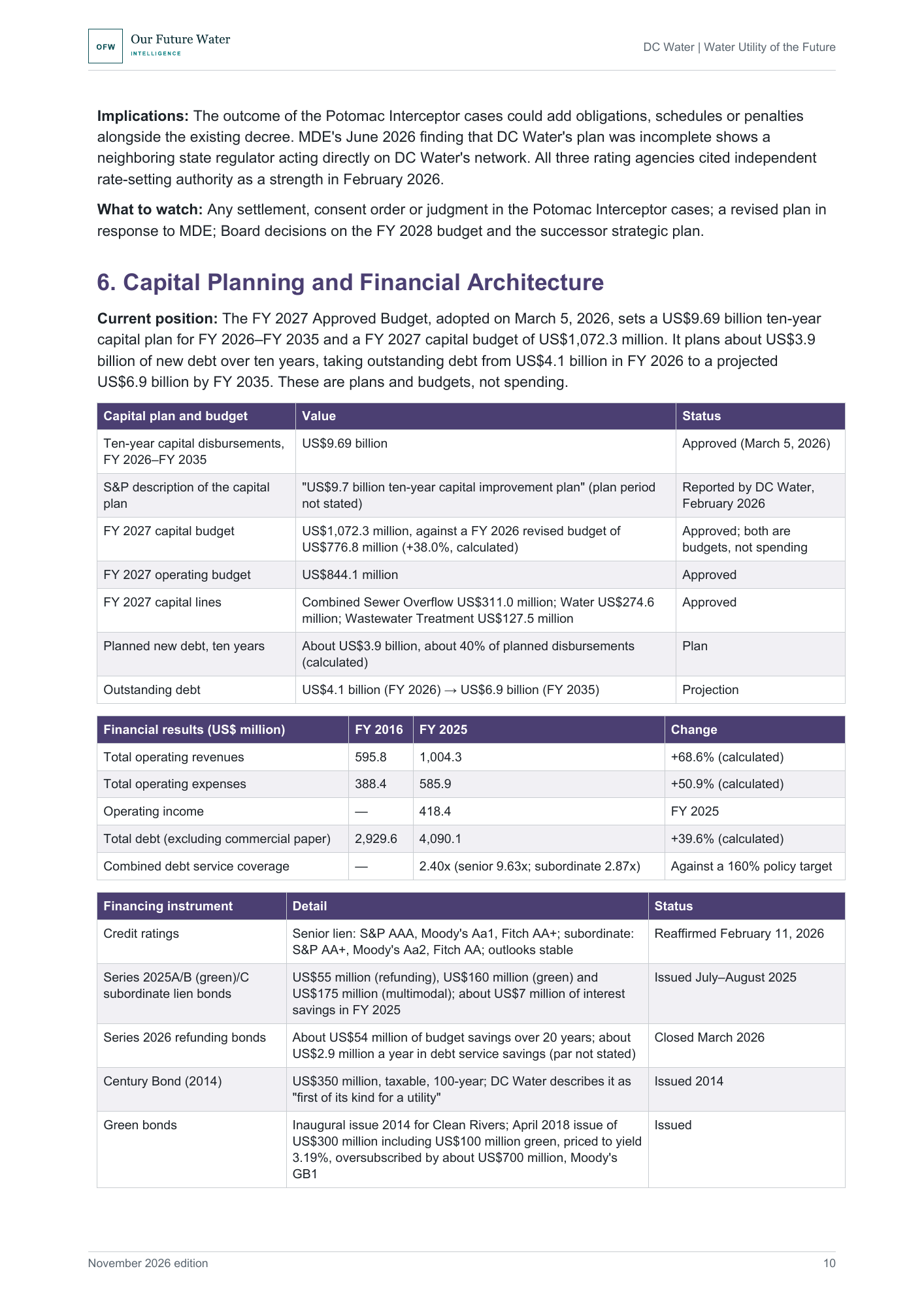
6. Capital Planning and Financial Architecture
The FY 2028 proposed budget and any revision of the US$9.69 billion plan; further refinancing after the March 2026 Series 2026 refunding; rating agency commentary after the litigation; FY 2026 coverage in the next ACFR.
3. Infrastructure Strategy for a Non-Stationary Climate
TBM Emily's start and tunneling progress on the Potomac River Tunnel; the Piney Branch schedule against end-2029; completion of the Clara Barton Parkway segment in February 2027; any revised cost for the Potomac Interceptor program.
5. Governance, Regulation, and Institutional Reform
Any settlement, consent order or judgment in the Potomac Interceptor cases; a revised plan in response to MDE; Board decisions on the FY 2028 budget and the successor strategic plan.
7. Strategic System Roadmap
TBM Emily's start; the Discovery Center opening; the Corps feasibility findings; the successor to Blueprint 2.0; any updated Lead Free DC schedule.
Capital plan, ten-year financial results and DC Water's financing instruments, from Section 6.
06
Included
What you receive
The complete PDF report: 15 pages, 10 sections, 17 tables and a register of 39 sources.
This edition
November 2026, First edition.
07
Evidence & method
Evidence and method
DC Water's FY 2025 ACFR statistical section, FY 2027 Approved Budget and approved FY 2027–FY 2028 rates; project pages and releases for the Clean Rivers tunnels, Pure Water DC, Lead Free DC and the Potomac Interceptor; and federal and state documents including the EPA consent decree and the April 2026 Justice Department complaint.
Sources
39 sources, listed in the report's source register. Evidence current to 12 November 2026. Principal data periods: FY 2025 results (fiscal year ended September 30, 2025); FY 2027 Approved Budget (adopted March 5, 2026); FY 2027 and FY 2028 rates (approved September 3, 2026); calendar 2024 water quality data; project status checked to November 12, 2026. All currency is US dollars..
Evidence boundaries
This report uses authoritative source material available at the stated research cutoff. It distinguishes published facts, calculated values and analytical interpretation. No independent modelling is performed. Forward-looking analysis reflects published plans, documented trends and stated uncertainties. It does not constitute legal, financial, investment or engineering advice.
08
Lead analyst
Robert C. Brears
Founder, Our Future Water Intelligence
Robert C. Brears is a water-security specialist and author whose work examines utility governance, infrastructure investment, climate resilience and long-term water-system change for executive and policy audiences.
- Decision-focused utility intelligence
- Published water-policy author
- Evidence-grounded system analysis
09
Buyer FAQs
Before you purchase
Who can use the report?
Licensed for internal use within one purchasing organization. The PDF and its contents may be shared with colleagues within that organization. External redistribution, resale and public publication are prohibited without permission.
How is the report delivered?
The PDF is available to download immediately after confirmed payment, through our secure delivery system.
Can my organization buy wider access?
Institutional purchasing: For invoice enquiries, multi-organization licensing or broader access requirements, contact Our Future Water Intelligence.
10
Water Utility of the Future: DC Water
- Format
- Length
- 15 pages
- Edition
- November 2026, First edition
- Price
- USD 499
11
Report details
Publication details
- Publisher
- Our Future Water Intelligence
- Report family
- Water Utility Intelligence Report
- Edition
- November 2026, First edition
- Format
- Length
- 15 pages
- Reference
- OFW_EXT_WATER_UTILITY_OF_THE_FUTURE_DC_WATER_c7769bf53117
- Evidence current to
- 12 November 2026
14
Explore this report family
More Water Utility of the Future reports
Explore the same report family covering other utilities.
Water Utility of the Future
Water Utility of the Future: Department of Energy, Abu Dhabi Emirate
- Geography
- Abu Dhabi, United Arab Emirates
- Edition
- November 2026, New edition
- Length
- 16 pages
Water Utility of the Future
Water Utility of the Future: Water and Sanitation Directorate, City of Cape Town
- Geography
- Cape Town, South Africa
- Edition
- November 2026, New edition
- Length
- 14 pages
Water Utility of the Future
Water Utility of the Future: Electricity and Water Authority
- Geography
- Bahrain, Middle East
- Edition
- November 2026, New edition
- Length
- 15 pages