
01
Executive overview
Key findings
CLP 365 billion: tariff-linked investment plan for 2025–2030, as optimized (company, May 2026)
7.4%: additional tariff attached to the drought and climate works approved for 2025–2030
19% → about 40%: groundwater share of drinking water production in 2025 (22% in 2024; company, May 2026), and as targeted under the Biociudad roadmap, by 2030 according to one September 2026 report; the company described its current share as about 25% in September 2026
37 hours: supply autonomy during turbidity events, against a stated goal of 96 hours (company, May 2026); the general manager spoke of weeks in September 2026
02
Buyer relevance
Who the report is for
Suppliers of wells, pumping and treatment equipment
Size the Santiago West, Santiago South and Fajas de Canales well fields, which add up to 3,190–3,200 L/s, and see which are under construction.
Credit and equity analysts covering Chilean utilities
Track net debt to EBITDA (3.53x at June 2026), the 75% payout on 2025 earnings and the CLP 200–250 billion average annual investment plan.
Water policy and basin planning teams
Follow how the Retorno Maipo dispute tests private water exchanges under the 2022 Water Code reform and the adaptation plan published in September 2026.
Network and leakage technology providers
Compare loss indicators, such as an infrastructure leakage index of 43.2 in 2025, with renewal rates and the metering programs launched in 2025.
03
Decision scope
Questions answered
How much is Aguas Andinas planning to invest in 2025–2030?
The tariff-linked plan is CLP 365 billion as optimized in May 2026, within an average annual investment of CLP 200–250 billion.
How long can Santiago keep water flowing during a turbidity event?
The company gives 37 hours of autonomy, against a stated goal of 96 hours.
How fast is the drinking water network being renewed?
The FY 2025 report gives a replacement rate of 0.2% for drinking water pipes, which implies a cycle of about 500 years.
What does the climate works tariff add to bills?
The 2025–2030 settlement adds a 7.4% tariff for drought and climate works; the May 2026 presentation gives 7.51% phased to 2031.
04
Inside the report
Inside the complete report
Executive Snapshot
1. From Service Provider to System Operator
2. System Intelligence and Digital Control
3. Energy, Carbon, and Resource Decoupling
4. Infrastructure Strategy for a Non-Stationary Climate
5. Customers, Demand, and the Water Prosumer
6. Governance, Regulation, and Institutional Reform
7. Capital Planning and Financial Architecture
8. Strategic System Roadmap
Conclusion
Source Register
05
Public preview
What to watch next
7. Capital Planning and Financial Architecture
FY 2026 capital spending against the CLP 200–250 billion range; net debt to EBITDA at year-end 2026; the payout approved at the April 2027 shareholders' meeting.
6. Governance, Regulation, and Institutional Reform
The first-instance ruling in the Retorno Maipo case; the Maipo basin strategic plan; SISS service-quality sanctions, which feed into the next tariff process.
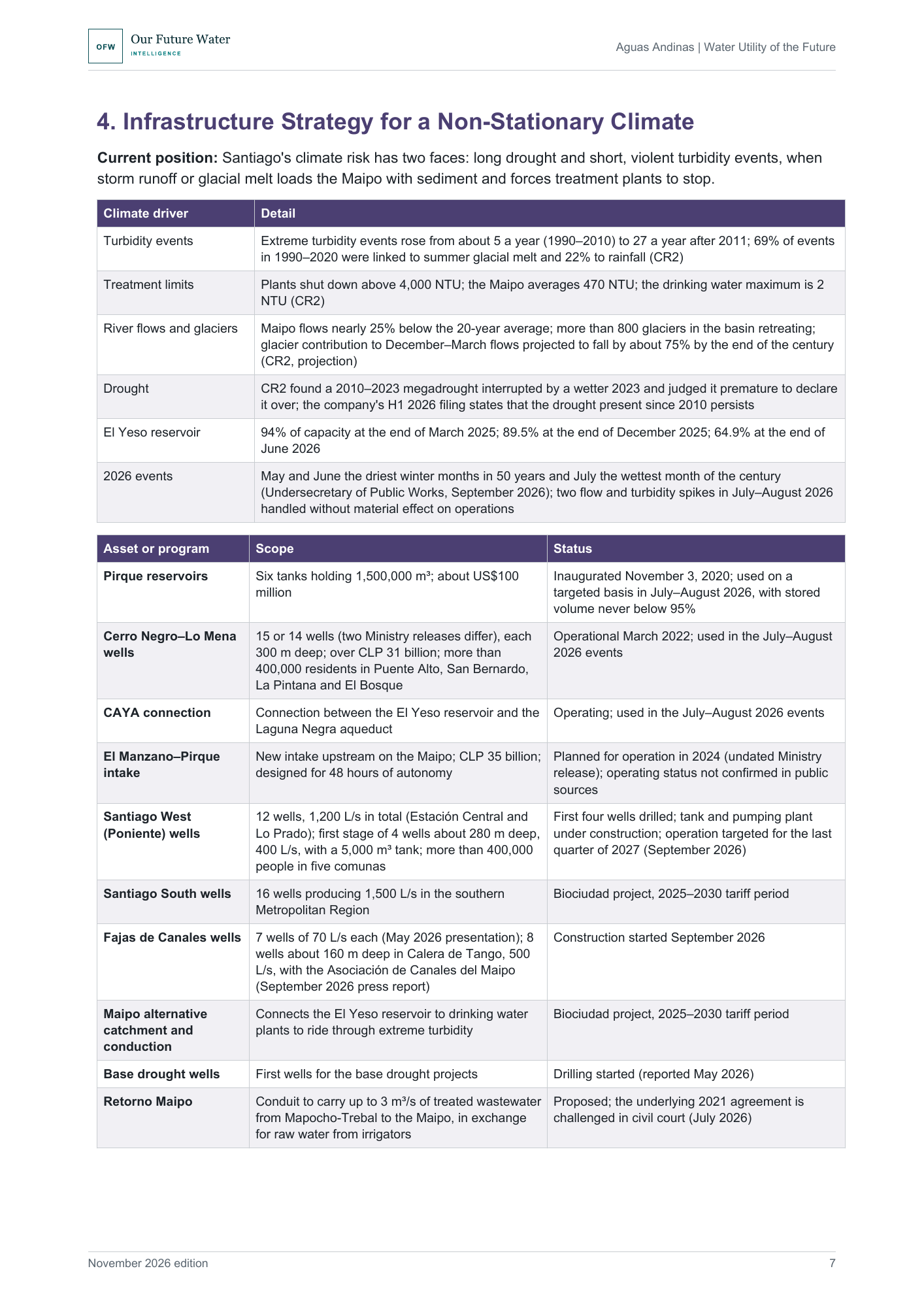
4. Infrastructure Strategy for a Non-Stationary Climate
Commissioning of the first Santiago West stage in late 2027; reported autonomy hours; El Yeso storage through the 2026–2027 summer.
5. Customers, Demand, and the Water Prosumer
Complaint numbers and their network share in FY 2026; overdue debt; the use of the variable transfer tariff in the 2026–2027 summer.
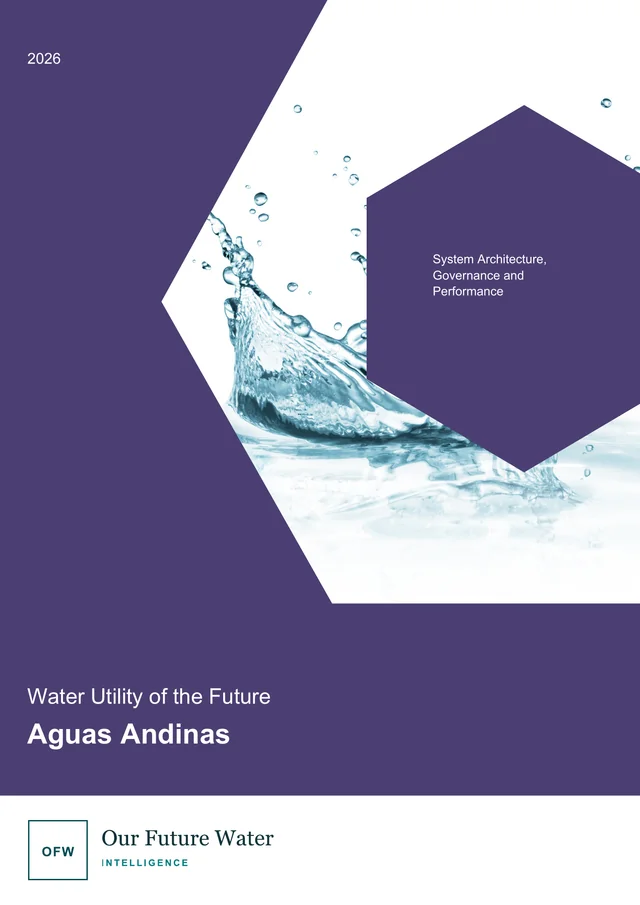
Climate drivers, the asset program from Pirque to Retorno Maipo, and autonomy against turbidity outages.
06
Included
What you receive
The complete PDF report: 16 pages, 11 sections, 23 tables and a register of 33 sources.
This edition
November 2026, First edition.
07
Evidence & method
Evidence and method
The report draws on Aguas Andinas' integrated reports and data tables for 2016 to 2025, its H1 2026 financial filing and 2023–2026 investor presentations, and the regulator's 2020–2025 tariff study. It adds Chilean government and climate science publications on the Maipo basin, and press reporting on projects and litigation checked in November 2026.
Sources
33 sources, listed in the report's source register. Evidence current to 2 November 2026. Principal data periods: FY 2025 integrated report and data tables (year ended December 31, 2025); H1 2026 results (six months to June 30, 2026); the 2025–2030 tariff period. Project, rating, legal and regulatory status checked on November 2, 2026. All currency is Chilean pesos (CLP) unless stated..
Evidence boundaries
This report uses authoritative source material available at the stated research cutoff. It distinguishes published facts, calculated values and analytical interpretation. No independent modelling is performed. Forward-looking analysis reflects published plans, documented trends and stated uncertainties. It does not constitute legal, financial, investment or engineering advice.
08
Lead analyst
Robert C. Brears
Founder, Our Future Water Intelligence
Robert C. Brears is a water-security specialist and author whose work examines utility governance, infrastructure investment, climate resilience and long-term water-system change for executive and policy audiences.
- Decision-focused utility intelligence
- Published water-policy author
- Evidence-grounded system analysis
09
Buyer FAQs
Before you purchase
Who can use the report?
Licensed for internal use within one purchasing organization. The PDF and its contents may be shared with colleagues within that organization. External redistribution, resale and public publication are prohibited without permission.
How is the report delivered?
The PDF is available to download immediately after confirmed payment, through our secure delivery system.
Can my organization buy wider access?
Institutional purchasing: For invoice enquiries, multi-organization licensing or broader access requirements, contact Our Future Water Intelligence.
10
Water Utility of the Future: Aguas Andinas
- Format
- Length
- 16 pages
- Edition
- November 2026, First edition
- Price
- USD 499
11
Report details
Publication details
- Publisher
- Our Future Water Intelligence
- Report family
- Water Utility Intelligence Report
- Edition
- November 2026, First edition
- Format
- Length
- 16 pages
- Reference
- OFW_EXT_WATER_UTILITY_OF_THE_FUTURE_AGUAS_ANDINAS_6ade499f7e95
- Evidence current to
- 2 November 2026
14
Explore this report family
More Water Utility of the Future reports
Explore the same report family covering other utilities.
Water Utility of the Future
Water Utility of the Future: Department of Energy, Abu Dhabi Emirate
- Geography
- Abu Dhabi, United Arab Emirates
- Edition
- November 2026, New edition
- Length
- 16 pages
Water Utility of the Future
Water Utility of the Future: Water and Sanitation Directorate, City of Cape Town
- Geography
- Cape Town, South Africa
- Edition
- November 2026, New edition
- Length
- 14 pages
Water Utility of the Future
Water Utility of the Future: Electricity and Water Authority
- Geography
- Bahrain, Middle East
- Edition
- November 2026, New edition
- Length
- 15 pages