
01
Executive overview
Key findings
63%, 19% and 18%: shares of desalinated seawater, groundwater and reused treated wastewater in 1,065 million m³ of total water production (2023)
200 million m³ vs 49.6 million m³: estimated groundwater abstraction (2023) against the aquifers' long-term safe yield; 180 million m³ of it went to agriculture
538 MIGD vs 420 MIGD: potable desalination capacity and water demand (2024); capacity is expected to reach 648 MIGD when Facility E is commissioned in 2028
QAR 13.5 billion: value of the Facility E power and water agreement (May 2025), with USD 2,971 million of co-financing signed in January 2026
02
Buyer relevance
Who the report is for
Desalination developers, lenders and equipment suppliers
The single-buyer IWPP model, Facility E's sponsors, financing and commissioning dates, and the supply margin against demand.
Wastewater and network contractors
Which Ashghal and KAHRAMAA projects are under construction, completed or awaiting commissioning, with the published capital plans behind them.
Consultants and policy advisers
Who owns, operates, regulates and prices water in Qatar, the 2025 water law's compliance timetable, and the conflicting 2030 targets side by side.
Agriculture and food security planners
Groundwater abstraction by farms against safe yield, treated wastewater prices for fodder, and the national reduction targets.
03
Decision scope
Questions answered
Where does Qatar's water come from?
Of 1,065 million m³ of water in 2023, desalinated seawater supplied 63%, groundwater 19% and reused treated wastewater 18%.
How large is the gap between groundwater use and recharge?
Estimated abstraction was 200 million m³ in 2023, about four times the long-term safe yield of 49.6 million m³; 180 million m³ went to agriculture.
Is more desalination capacity coming?
Facility E, a QAR 13.5 billion power and water plant, is due to add 110 MIGD of reverse osmosis by 1 August 2028, lifting capacity to an expected 648 MIGD.
What do water customers pay?
KAHRAMAA's tariff pages show categories but no rate table; a 2015 schedule reported QAR 4.40 to 7.40 per m³, and Ashghal adds a wastewater fee of 20% of the bill for non-Qatari households and organisations.
04
Inside the report
Inside the complete report
Executive Snapshot
1. Country Water Profile
2. Water Resources and Supply
3. Institutions and Utilities
4. Infrastructure and Major Projects
5. Tariffs and Finance
6. Climate and Resilience
7. Outlook and What to Watch
Source Register
05
Public preview
What to watch next
2. Water Resources and Supply
Well-level metering results; 2025 demand against the 428 MIGD forecast; any reconciliation of the 74.7 and 150.5 million m³ resource figures.
3. Institutions and Utilities
Implementing decisions as the compliance period ends; how the law treats the 2015 groundwater decree; targets under KAHRAMAA's 2026–2030 strategy.
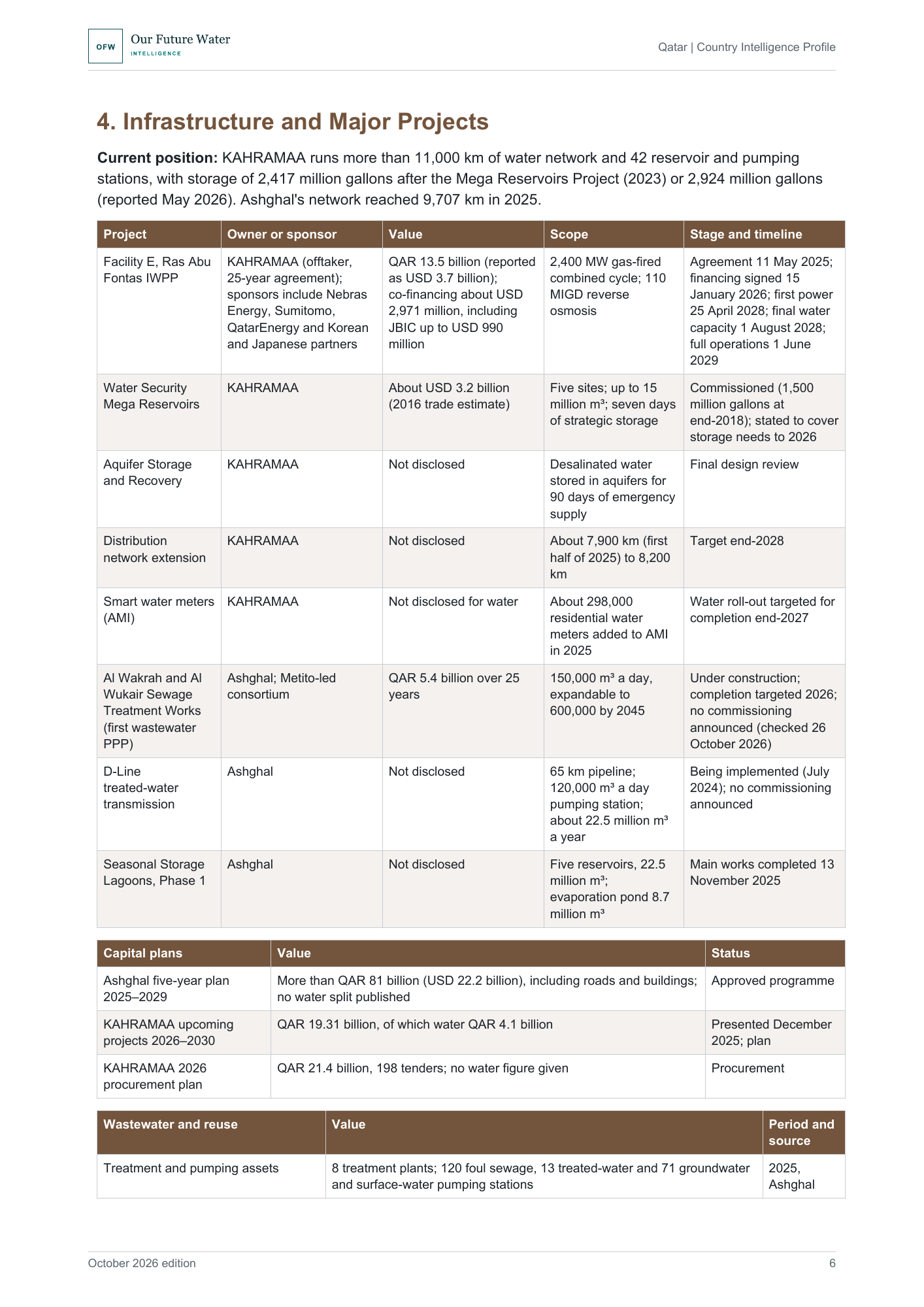
4. Infrastructure and Major Projects
Facility E's 2028 milestones; commissioning of Al Wakrah and Al Wukair and the D-Line; storage plans as the Mega Reservoirs' 2026 horizon passes; a second wastewater PPP phase.
5. Tariffs and Finance
A published tariff resolution or KAHRAMAA schedule; Nebras Energy's third-quarter 2026 results; any KAHRAMAA disclosure of subsidy or cost recovery.
Infrastructure and Major Projects: owner, value, scope, stage and timeline for Facility E, the Mega Reservoirs, the first wastewater PPP and other projects, with KAHRAMAA and Ashghal capital plans.
06
Included
What you receive
The complete PDF report: 12 pages, 9 sections, 12 tables and a register of 47 sources.
This edition
October 2026 edition. National Planning Council water statistics for 2023 and KAHRAMAA operating data for 2024 and 2025. Law No. 23 of 2025 on water and the six-month compliance extension from 19 June 2026. Facility E's financing, signed in January 2026, and its 2028 and 2029 commissioning dates. Nebras Energy's audited 2025 results and KAHRAMAA's 2026–2030 strategy; regulatory and project status checked on 26 October 2026. New edition, October 2026, with evidence current to 26 October 2026. Replaces the earlier edition for new buyers; buyers of an earlier edition keep access to the edition they bought.
07
Evidence & method
Evidence and method
Built on National Planning Council water statistics, KAHRAMAA's statistics report and water-sector data, the national open data portal, Nebras Energy's audited accounts, Ashghal and state news agency announcements, project financing releases, Qatar's national strategies and climate submissions, and UN and World Bank series.
Sources
47 sources, listed in the report's source register. Evidence current to 26 October 2026. Principal data periods: National Planning Council water statistics for 2023 (November 2024); KAHRAMAA data for 2023 to 2025; Nebras Energy audited results for 2025; regulatory and project status checked on 26 October 2026. Currency is Qatari riyals (QAR), with US dollars (USD) where the source states them..
Evidence boundaries
This report uses authoritative source material available at the stated research cutoff. It distinguishes published facts, calculated values and analytical interpretation. No independent modelling is performed. Forward-looking analysis reflects published plans, documented trends and stated uncertainties. It does not constitute legal, financial, investment or engineering advice.
08
Lead analyst
Robert C. Brears
Founder, Our Future Water Intelligence
Robert C. Brears is a water-security specialist and author whose work examines utility governance, infrastructure investment, climate resilience and long-term water-system change for executive and policy audiences.
- Decision-focused utility intelligence
- Published water-policy author
- Evidence-grounded system analysis
09
Buyer FAQs
Before you purchase
Who can use the report?
Licensed for internal use within one purchasing organization. The PDF and its contents may be shared with colleagues within that organization. External redistribution, resale and public publication are prohibited without permission.
How is the report delivered?
The PDF is available to download immediately after confirmed payment, through our secure delivery system.
Can my organization buy wider access?
Institutional purchasing: For invoice enquiries, multi-organization licensing or broader access requirements, contact Our Future Water Intelligence.
10
Qatar Country Intelligence Profile
- Format
- Length
- 12 pages
- Edition
- October 2026 edition
- Price
- USD 99
11
Report details
Publication details
- Publisher
- Our Future Water Intelligence
- Report family
- Country Intelligence Profile
- Report type
- National Water Research and Reference
- Edition
- October 2026 edition
- Format
- Length
- 12 pages
- Reference
- ofw-profile-country-qat_de934253b326
- Evidence current to
- 26 October 2026
14
Explore this report family
More Country Intelligence Profiles
Explore the same report family covering other countries.
Oman Country Intelligence Profile
- Geography
- Oman
- Edition
- November 2026, First edition
- Length
- 14 pages
Kuwait Country Intelligence Profile
- Geography
- Kuwait
- Edition
- November 2026, First edition
- Length
- 14 pages
National Water Research and Reference
Saudi Arabia Country Intelligence Profile
- Geography
- Saudi Arabia
- Edition
- November 2026 edition
- Length
- 15 pages