
01
Executive overview
Key findings
69.3%: system storage at 1 September 2026, of 1,812 GL total capacity
150 GL: desalinated water ordered for 2026/27, the plant's full annual capacity
169 litres: residential use per person per day in 2024-25, against the voluntary Target 150
A$7.3 billion: Melbourne Water infrastructure investment approved for 2026-31
02
Buyer relevance
Who the report is for
Suppliers and contractors entering the Melbourne water market
Use the project table to see which of Melbourne Water and the three retailers own each programme, its value and its stage.
Investors and analysts covering Victorian infrastructure
Compare Melbourne Water's A$7,307.7 million 2026-31 capital benchmark with its A$963.1 million capital spend in 2024-25.
Consultants preparing a first briefing on Melbourne
Take the City Water Profile table as a sourced one-page reference for population, sources, annual supply and institutions.
Policy and planning teams tracking water security
Follow the dated milestones, from the 30 November 2026 storage assessment to the Water Security Taskforce report in 2027.
03
Decision scope
Questions answered
Where does Melbourne's water come from?
Mostly from protected forested catchments, with open catchments supplying about a quarter and the Victorian Desalination Plant able to deliver up to 150 GL a year.
How full are Melbourne's storages?
Storage was 69.3% of the 1,812 GL system capacity on 1 September 2026, after falling to 63.4% on 1 June 2026.
Who runs water in Melbourne?
Melbourne Water supplies bulk water and treats most sewage, and three state-owned retailers serve customers: Yarra Valley Water, South East Water and Greater Western Water.
How much are water bills rising?
The commission's 30 June 2026 release puts the average typical Melbourne owner-occupier bill at A$1,158 for 2026-27, up 6.8%.
What new supply is being considered?
More desalination and a recycled drinking water pilot costing A$20–50 million to build, with a Water Security Taskforce reporting to government in 2027.
04
Inside the report
Inside the complete report
Executive Snapshot
1. City Water Profile
2. Water Resources and Supply
3. Institutions and Utilities
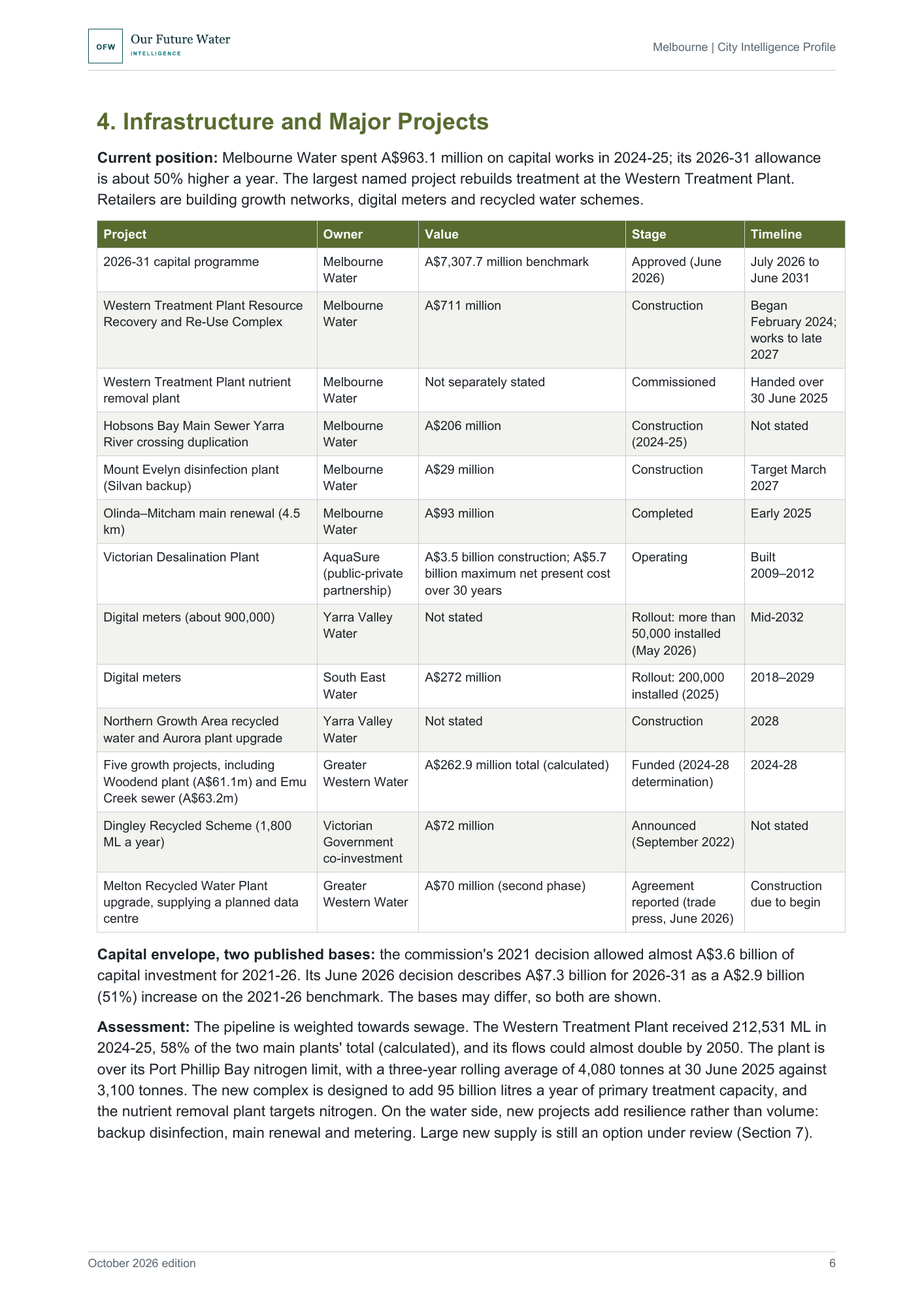
4. Infrastructure and Major Projects
5. Tariffs and Finance
6. Climate and Resilience
7. Outlook and What to Watch
Source Register
05
Public preview
What to watch next
5. Tariffs and Finance
The commission's 2025-26 performance report; 2027-28 price adjustments; order costs if the desalination plant stays at 150 GL.
4. Infrastructure and Major Projects
Completion of the Western Treatment Plant complex and the nitrogen trend; 2026-27 capital spend against the benchmark; the pace of both meter rollouts.
2. Water Resources and Supply
Storage on 30 November 2026, which sets the 2027 zone; any restrictions over summer 2026/27; the 2027/28 desalination order; 2025-26 residential use against the 150 litre target.
3. Institutions and Utilities
The state election on 28 November 2026; Greater Western Water's progress under its undertaking; the 2028 price reviews covering all three retailers.
Section 4: Melbourne's major water projects, with owner, value, stage and timeline.
06
Included
What you receive
The complete PDF report: 12 pages, 9 sections, 12 tables and a register of 30 sources.
This edition
October 2026 edition. Covers the 2024-25 financial year, with storage and desalination positions to 1 September 2026. Includes the Essential Services Commission's June 2026 decision approving Melbourne Water's 2026-31 prices and 2026-27 bills. Includes the 150 GL desalination order for 2026/27 and the Water Security Taskforce due to report in 2027. Time-sensitive facts were re-checked on 26 October 2026. New edition, October 2026, with evidence current to 26 October 2026. Replaces the earlier edition for new buyers; buyers of an earlier edition keep access to the edition they bought.
07
Evidence & method
Evidence and method
The profile draws on Melbourne Water's 2024-25 annual and water quality reports, the joint Annual Water Outlook and 2026 storage updates, the retailers' annual reports, Essential Services Commission price decisions and performance reports, Australian Bureau of Statistics population estimates, and Victorian Government and Infrastructure Victoria water security publications.
Sources
30 sources, listed in the report's source register. Evidence current to 26 October 2026. Principal data periods: 2024-25 financial year (1 July 2024 to 30 June 2025) audited and statutory reports; storage and desalination position to 1 September 2026; 2026-31 and 2026-27 price decisions (June 2026). All currency is Australian dollars (A$)..
Evidence boundaries
This report uses authoritative source material available at the stated research cutoff. It distinguishes published facts, calculated values and analytical interpretation. No independent modelling is performed. Forward-looking analysis reflects published plans, documented trends and stated uncertainties. It does not constitute legal, financial, investment or engineering advice.
08
Lead analyst
Robert C. Brears
Founder, Our Future Water Intelligence
Robert C. Brears is a water-security specialist and author whose work examines utility governance, infrastructure investment, climate resilience and long-term water-system change for executive and policy audiences.
- Decision-focused utility intelligence
- Published water-policy author
- Evidence-grounded system analysis
09
Buyer FAQs
Before you purchase
Who can use the report?
Licensed for internal use within one purchasing organization. The PDF and its contents may be shared with colleagues within that organization. External redistribution, resale and public publication are prohibited without permission.
How is the report delivered?
The PDF is available to download immediately after confirmed payment, through our secure delivery system.
Can my organization buy wider access?
Institutional purchasing: For invoice enquiries, multi-organization licensing or broader access requirements, contact Our Future Water Intelligence.
10
Melbourne City Intelligence Profile
- Format
- Length
- 12 pages
- Edition
- October 2026 edition
- Price
- USD 99
11
Report details
Publication details
- Publisher
- Our Future Water Intelligence
- Report family
- City Intelligence Profile
- Report type
- Urban Water Research and Reference
- Edition
- October 2026 edition
- Format
- Length
- 12 pages
- Reference
- ofw-profile-city-au-melbourne_e5ec6b8789a6
- Evidence current to
- 26 October 2026
14
Explore this report family
More City Intelligence Profiles
Explore the same report family covering other cities.
Muscat City Intelligence Profile
- Geography
- Oman
- Edition
- November 2026, New edition
- Length
- 13 pages
Jeddah City Intelligence Profile
- Geography
- Saudi Arabia
- Edition
- November 2026, First edition
- Length
- 13 pages
Doha City Intelligence Profile
- Geography
- Qatar
- Edition
- November 2026, First edition
- Length
- 13 pages