
01
Executive overview
Key findings
4 water companies, 1 sewerage company: Thames Water supplies most of London and is the sole sewerage undertaker; Affinity Water, SES Water and Essex & Suffolk Water supply parts of outer London
53.1%: Lower Thames reservoir storage at the end of September 2026; a hosepipe ban has applied since 23 July 2026
86.24%: Thames Water regulatory gearing at 31 March 2026, against a Regulatory Capital Value of £22,725 million (company-wide)
86%: modelled fall in storm overflow volume to the tidal Thames in 2025 after the Thames Tideway Tunnel came into use
02
Buyer relevance
Who the report is for
Firms supplying or advising London's water companies
Check the stage, owner and timeline of each major project, from the Thames Tideway Tunnel to the White Horse Reservoir application expected in November 2026.
Lenders and credit analysts covering Thames Water
Read Regulatory Capital Value, gearing, net debt and liquidity for 2023/24 to 2025/26 alongside the status of the recapitalisation at 26 October 2026.
Property developers and large water users in London
Compare the 2026/27 metered charges of all four suppliers and the drought restrictions in force since 23 July 2026.
Public bodies and consultants new to London's water sector
Use the institutions table to see which body regulates prices, abstraction, drinking water and planning, and what the planned single regulator changes.
03
Decision scope
Questions answered
Who supplies water in London?
Thames Water supplies most of London and is the sole sewerage undertaker; Affinity Water, SES Water and Essex & Suffolk Water supply parts of outer London.
How low were London's reservoirs in 2026?
The Lower Thames reservoirs were 53.1% full at the end of September 2026, down from 59.4% at the end of August.
How indebted is Thames Water?
Statutory net debt was £18,516 million at 31 March 2026, and regulatory gearing was 86.24% against a Regulatory Capital Value of £22,725 million.
When could London get a new water source?
The Teddington Direct River Abstraction scheme is planned to operate from 2033, and the White Horse Reservoir is targeted for 2040; neither has yet received development consent.
What do metered households pay Thames Water in 2026/27?
The metered water charge is £66.87 a year plus 273.46p per m3, and wastewater is £128.13 a year plus 147.21p per m3.
04
Inside the report
Inside the complete report
Executive Snapshot
1. City Water Profile
2. Water Resources and Supply
3. Institutions and Utilities
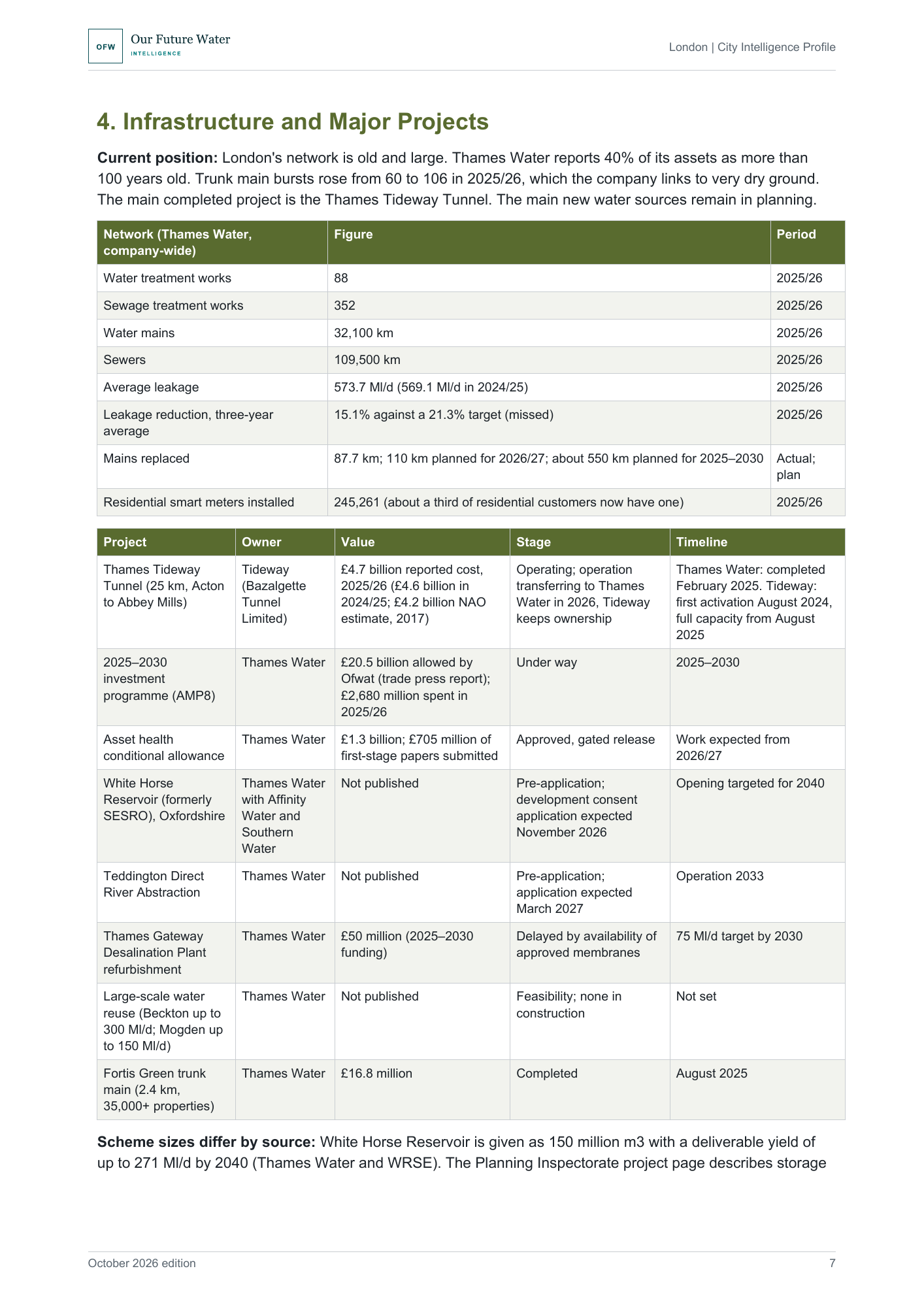
4. Infrastructure and Major Projects
5. Tariffs and Finance
6. Climate and Resilience
7. Outlook and What to Watch
Source Register
05
Public preview
What to watch next
2. Water Resources and Supply
Monthly Environment Agency reservoir reports through winter 2026/27; whether the hosepipe ban is lifted or escalated; desalination reliable output against the 50 Ml/d interim level.
3. Institutions and Utilities
Defra's Transition Plan, promised for 2026, and the water bill promised during this Parliament; the adopted text of the new London Plan's water policies.
4. Infrastructure and Major Projects
Acceptance of the White Horse Reservoir application; mains replacement against the 110 km plan for 2026/27; release of the remaining asset health funding stages.
5. Tariffs and Finance
The outcome of the 29 October 2026 creditor vote on emergency funding; any court-sanctioned restructuring plan; credit ratings and the P26 breach; the 2027/28 charges scheme.
Section 4: London's water network and major projects, with owner, value, stage and timeline for each scheme.
06
Included
What you receive
The complete PDF report: 13 pages, 9 sections, 20 tables and a register of 36 sources.
This edition
October 2026 edition. Covers Thames Water's 2025/26 regulatory year, to 31 March 2026, and the 2026/27 charges of all four London water suppliers. Includes the 2026 drought: the hosepipe ban from 23 July 2026 and reservoir storage to the end of September 2026. Includes the Thames Tideway Tunnel's 2025 results and the 2026 transfer of its operation to Thames Water. Sets out the status of Thames Water's recapitalisation and emergency funding as at 26 October 2026, and Defra's January 2026 plan for a single water regulator. New edition, October 2026, with evidence current to 26 October 2026. Replaces the earlier edition for new buyers; buyers of an earlier edition keep access to the edition they bought.
07
Evidence & method
Evidence and method
The profile draws on the water companies' 2025/26 regulatory reports, annual results and 2026/27 charges schemes; Thames Water's Water Resources Management Plan 2024 and Drought Plan; Environment Agency, ONS, Greater London Authority and Defra publications; and Planning Inspectorate project records. Drought, project and recapitalisation status were checked to 26 October 2026.
Sources
36 sources, listed in the report's source register. Evidence current to 26 October 2026. Principal data periods: ONS mid-2025 population; water company regulatory year 2025/26 (year ended 31 March 2026); 2026/27 charges (from 1 April 2026); drought, project and recapitalisation status checked to 26 October 2026. All currency is pounds sterling (GBP)..
Evidence boundaries
This report uses authoritative source material available at the stated research cutoff. It distinguishes published facts, calculated values and analytical interpretation. No independent modelling is performed. Forward-looking analysis reflects published plans, documented trends and stated uncertainties. It does not constitute legal, financial, investment or engineering advice.
08
Lead analyst
Robert C. Brears
Founder, Our Future Water Intelligence
Robert C. Brears is a water-security specialist and author whose work examines utility governance, infrastructure investment, climate resilience and long-term water-system change for executive and policy audiences.
- Decision-focused utility intelligence
- Published water-policy author
- Evidence-grounded system analysis
09
Buyer FAQs
Before you purchase
Who can use the report?
Licensed for internal use within one purchasing organization. The PDF and its contents may be shared with colleagues within that organization. External redistribution, resale and public publication are prohibited without permission.
How is the report delivered?
The PDF is available to download immediately after confirmed payment, through our secure delivery system.
Can my organization buy wider access?
Institutional purchasing: For invoice enquiries, multi-organization licensing or broader access requirements, contact Our Future Water Intelligence.
10
London City Intelligence Profile
- Format
- Length
- 13 pages
- Edition
- October 2026 edition
- Price
- USD 99
11
Report details
Publication details
- Publisher
- Our Future Water Intelligence
- Report family
- City Intelligence Profile
- Report type
- Urban Water Research and Reference
- Edition
- October 2026 edition
- Format
- Length
- 13 pages
- Reference
- ofw-profile-city-gb-london_a6f9cf8ebc5f
- Evidence current to
- 26 October 2026
14
Explore this report family
More City Intelligence Profiles
Explore the same report family covering other cities.
Muscat City Intelligence Profile
- Geography
- Oman
- Edition
- November 2026, New edition
- Length
- 13 pages
Jeddah City Intelligence Profile
- Geography
- Saudi Arabia
- Edition
- November 2026, First edition
- Length
- 13 pages
Doha City Intelligence Profile
- Geography
- Qatar
- Edition
- November 2026, First edition
- Length
- 13 pages